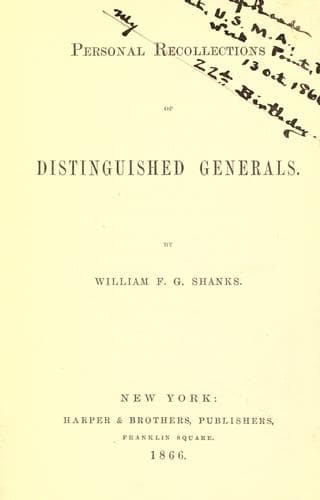
Personal Recollections of Distinguished GeneralsShanks, William Franklin Gore
History
Personal Recollections of Distinguished Generals
Shanks, William Franklin Gore
Generals -- United States; United States -- History -- Civil War, 1861-1865 -- Biography
The two men thus made the scapegoats of Rosecrans were men of more
than ordinary abilities, and it is a great pity that the reputation
of such men should ever be placed in the hands of such generals as
Rosecrans. General Negley, though not educated for the army, was one of
the best-read officers in military matters that we had in the volunteer
service, and possessed a natural adaptation for, and many qualities
as a leader. He was a man of quick perception and decided judgment,
intuitive talents which "stood him in hand" on more than one occasion,
as, for instance, at Stone River, where he replied to Breckenridge's
assault of his troops by a counter-charge which, made with great force
and rapidity, turned the fortunes of the day, and won an advantage
which decided Bragg to abandon the field of which he was still master.
Bragg relieved Breckenridge from his command for his defeat by Negley.
Among the most important services rendered by General Negley, or by
any other general officer of the army, were the operations embracing
the reconnoissance and battle at Dug Gap, Georgia, on September 11,
1863. He commanded the advance of the centre column of Rosecrans's
army in crossing Lookout Mountain. The three columns had been widely
separated--fifty miles intervening between the right wing and centre,
and about thirty between the centre and left wing. Knowing this,
Bragg had concentrated his forces in front of the centre, abandoning
Chattanooga in such a way as to indicate he was in full retreat.
Rosecrans ordered him to be pursued, and General Negley, debouching
from Stevens's Gap of Lookout Mountain, was ordered to take Lafayette,
Georgia. General Negley was advised and had reported that Bragg was
concentrating his forces at that very point, but the report was
discredited by General Rosecrans, and Negley was ordered forward. He
advanced cautiously on the morning of September 11, in command of his
own and Baird's divisions, and, as he anticipated, soon encountered
the enemy. He drove them for some time, but soon found that he had
Bragg's whole army in his front and on his flanks. It was subsequently
discovered that Bragg had issued positive and peremptory orders to
Generals Hindman, Hill, Buckner, and Polk, to attack and destroy
Negley, promising himself the easy capture of the other columns in
detail. But Negley was too shrewd to be caught thus; although his
trains and those of Baird encumbered the road in his rear, which the
enemy soon threatened by moving on his flanks, he succeeded in saving
every wagon and in slowly retiring on Stevens's Gap, where he could
afford to battle with thrice his numbers. This engagement, which lasted
all the day, was the first convincing proof which Rosecrans had of the
presence of Bragg, and the first premonition of danger. It induced him
to gather his scattered columns together. General Negley's discretion
and valor on this occasion were not only alike commended by Generals
Public-domain text, read in full here on John Shaqi.
Reviews
Reviews
No reviews yet
Be the first to share your thoughts on this work.
Elsewhere in the archive
Join the Discussion
Join the discussion
Sign in to leave a comment or review.
Sign InorCreate an account