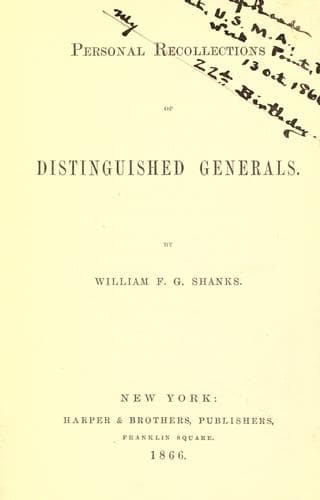
Personal Recollections of Distinguished GeneralsShanks, William Franklin Gore
History
Personal Recollections of Distinguished Generals
Shanks, William Franklin Gore
Generals -- United States; United States -- History -- Civil War, 1861-1865 -- Biography
Negley is one of the most accomplished horticulturists in the country,
and when in the field of war his leisure hours were devoted to the
study of various fruits, flowers, and shrubs in which the Southern
fields and woods abounded. Many a march, long, tedious, exhausting, has
been rendered delightful to his staff by his interesting descriptive
illustrations of the hidden beauties and virtues of fragrant flowers
and repulsive weeds. I have known him to spend hours in explaining the
properties of shrubs and wild-flowers which grew about his bivouac or
head-quarters, and he would, when on the march, frequently spring from
his saddle to pluck a sensitive plant, that he might "point a moral"
in showing how soon it, like life or fame, withered at the touch of
death or disgrace. He was a remarkably well-made man--something of the
robust, sinewy frame of Steedman and Buell. His grasp was like a vice.
He was as tough as he was strong, and as elastic as enduring. He was
an exceedingly prompt and active man, and his division of the Army of
the Cumberland was by far its best in drill, appointments, and in its
commissariat. Negley's troops used to boast that while he commanded
they had never, under any circumstances, wanted for food or clothing,
and they used frequently to call him "Commissary General Negley."
General Thomas J. Wood might in some slight respects be compared to
Negley, but they appear to better effect when drawn in contrast.
Negley was considered a martinet among volunteers, Wood a martinet
among regulars. I do not mean martinet in the sense which a few
brainless officers have given the title by their illustrations of
it, but in its proper sense, as indicating a thorough and efficient
disciplinarian. Both Negley and Wood made their men soldiers through
discipline, and there were no better soldiers in the army. Their fate,
too, was similar. The advancement of each was slow and labored, and
their friends began to fear that their promotion was to be of that
ungenerous, posthumous order which was too frequent, and which always
looked to me like giving a handsome tomb-stone to a man unjustly
treated all his life.
Public-domain text, read in full here on John Shaqi.
Reviews
Reviews
No reviews yet
Be the first to share your thoughts on this work.
Elsewhere in the archive
Join the Discussion
Join the discussion
Sign in to leave a comment or review.
Sign InorCreate an account