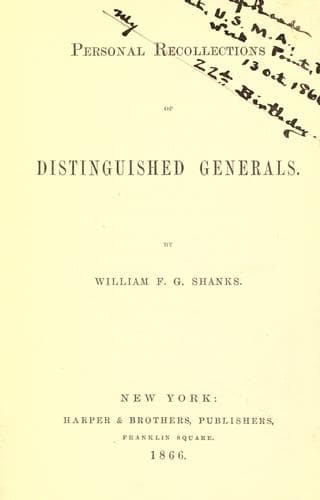
Personal Recollections of Distinguished GeneralsShanks, William Franklin Gore
History
Personal Recollections of Distinguished Generals
Shanks, William Franklin Gore
Generals -- United States; United States -- History -- Civil War, 1861-1865 -- Biography
General Wood was a captious officer, but a decided, brave, and
energetic one. History, which is rapidly beginning to be just,
and which will grow harsher every day, and more just with all her
harshness, will say that it was highly proper that the appointment of
General Wood as major general should read as it did--"vice Crittenden,
resigned." The place which that clever gentleman, but very poor
soldier, Thomas L. Crittenden, filled, was properly Tom Wood's years
before he got it, for he really filled it. Always under the command of
Crittenden, he was ever at his right hand and as his right hand, and
furnished him with all the military brains, and formed for him all the
military character he ever had. It may be impolite to say this now, but
it is anticipating history but a short time. This is a decree which
must be submitted to eventually, and why not now?
When the army of Rosecrans was drawing itself up in front of
Murfreesborough, Tennessee, the very day before the battle of
December 31, 1862, Crittenden's wing was on the left, and Tom Wood's
division held its advance. On approaching the rebel position, Wood,
of course, came to a halt, and, reconnoitering the position, reported
to Crittenden that the enemy were intrenched in his immediate front.
Crittenden went forward to Wood's position and satisfied himself of
the presence of the enemy in force, and approved the halt. A short
time after he received a communication from General Rosecrans stating
that General David S. Stanley, who, with his cavalry corps, had gone
to Murfreesborough, reported that the enemy had evacuated, and he
therefore ordered Crittenden to cross Stone River and occupy the
town. Crittenden showed the order to Wood, and told him that he must
advance and occupy the town. Wood argued that Rosecrans's information,
to his own and to Crittenden's knowledge, was incorrect, and that,
of course, it would not do to implicitly obey the order. Crittenden
thought that its terms were positive, and no course was left him but to
obey it. Wood urged Crittenden to report the circumstances, announce
to Rosecrans that the movement was delayed an hour in order to report
those facts, and stand ready to obey it if then repeated. It was some
time before Wood could make Crittenden understand that this was the
proper proceeding under the circumstances. He rode back to Rosecrans
and reported the facts, when that officer, examining for himself,
approved of the course pursued, and taught Crittenden that positive
orders were not always to be implicitly obeyed.
Public-domain text, read in full here on John Shaqi.
Reviews
Reviews
No reviews yet
Be the first to share your thoughts on this work.
Elsewhere in the archive
Join the Discussion
Join the discussion
Sign in to leave a comment or review.
Sign InorCreate an account