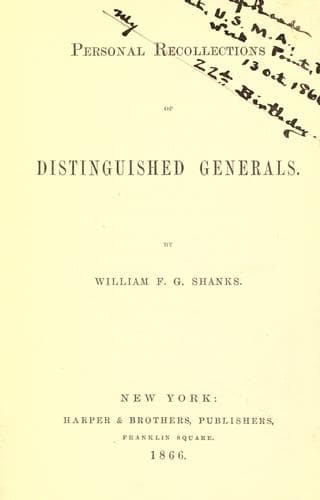
Personal Recollections of Distinguished GeneralsShanks, William Franklin Gore
History
Personal Recollections of Distinguished Generals
Shanks, William Franklin Gore
Generals -- United States; United States -- History -- Civil War, 1861-1865 -- Biography
In three years of active warfare Tom Wood won honor from every
action, from Shiloh to Nashville. The disasters of his corps
were not disasters for him. He came out of the crucibles refined
and sparkling with renewed glory. Whether proving, as he did at
Shiloh, that he had made by his discipline veterans out of men who
had never seen a battle--whether stemming the adverse current of
battle at Chickamauga--whether scaling with irresistible power the
heights of Mission Ridge, and carrying at the point of the bayonet
the strongly-manned position, which looked strong enough to hold
itself--whether repulsing the charge at Franklin, or making it
at Nashville, he stands forth prominent as one of the coolest,
self-possessed, and gallant spirits of the day. I was glad to
see him at the close of the war joining hands with his noble friend
Rousseau for the redemption of Kentucky from slavery, and uniting
with that band of progressive spirits to whom she will in a few years
acknowledge that she owes her prosperity and welfare.
[Illustration: OLIVER O. HOWARD.]
Among the many original characters whom I met, and who had been
developed by the war, and by no means the least remarkable of them,
was Major General Oliver Otis Howard. In many respects he was not
unlike General George H. Thomas, possessing the same quiet, dignified,
and reserved demeanor, the same methodical turn of mind, and the same
earnest, industrious habits; but Howard was Thomas with the addition
of several peculiarities, not to say eccentricities. He had none of
General Thomas's cold-bloodedness, and though, like him, a statue in
dignity of demeanor, Howard, unlike Thomas, had blood in him that often
flowed warm with sympathy, and pulses that sometimes beat quicker with
excitement. General Thomas guided himself in his course through life
by his immediate surroundings, adapting himself, without sycophancy,
however, to present circumstances without regard to past consistency,
and was in power and favor at all times, because content to obey as
long as he remained a subordinate. Howard began life with certain aims
in view, and sailed a straight course, remaining always constant to his
principles, and consequently finding himself, like all men with either
firm principles or advanced ideas, at times unpopular. He had little
of General Thomas's practicability, and General Thomas had little of
Howard's faith in the strength and final triumph of great principles.
One trusted in the physical strength, the other in the innate power
of the principles of a great cause. Thomas believed the late war the
triumph of good soldiers over their inferiors--the triumph of numbers,
skill, and strength; Howard will tell you, with a flush of feeling
and a slight touch of the extravagance of an enthusiast, that it was
the triumph of right over wrong. Thomas thinks, with Napoleon, that
God sides with the force that has the most cannon; Howard believes,
Public-domain text, read in full here on John Shaqi.
Reviews
Reviews
No reviews yet
Be the first to share your thoughts on this work.
Elsewhere in the archive
Join the Discussion
Join the discussion
Sign in to leave a comment or review.
Sign InorCreate an account