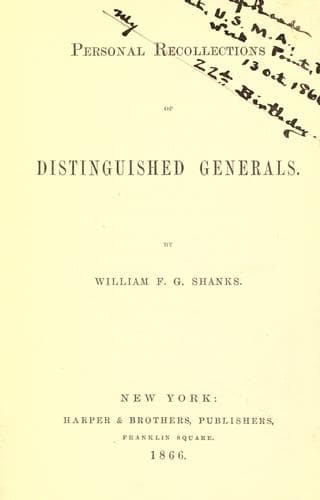
Personal Recollections of Distinguished GeneralsShanks, William Franklin Gore
History
Personal Recollections of Distinguished Generals
Shanks, William Franklin Gore
Generals -- United States; United States -- History -- Civil War, 1861-1865 -- Biography
"A vigorous, various, versatile mind,"
which grasped a subject as if to struggle with it, and pursued an
idea "to the death." It was, however, only his convictions in regard
to great principles that he inculcated and forced upon others. He
originated so much that he executed too little, and never gave
practical effect to two or three of his mechanical inventions which
have made fortunes for more practical and more shallow men. Sidell was
in some respects the only counterpart I ever met to Sherman, and the
parallel between them only held good with regard to their head work.
They conceived equally, but Sherman executed most.
General Howard possessed these same attributes of firm, honest
conviction, and the same fixedness of principles which distinguished
Sidell. His moral honesty won him more admiration than his speeches
or his abilities as a soldier; for, though energetic and persevering
in his administration as a commander, and generally successful in his
military efforts, his reputation in the army was more that of the
Christian gentleman than of the great soldier. It was through the
constant observation of his Christian duties that he won the title of
the "Havelock of the war" and the reputation of an exemplar. He was
strictly temperate, never imbibing intoxicating drinks, never profane,
and always religious. There was not a great excess of religion in the
army, particularly among the general officers, and Howard therefore
became a prominent example, the more particularly as religion was
looked upon by a great majority of the men only to be ridiculed. There
was very little of religious feeling among the men of the army, save
among those in the hospital. The hospital was the church of the camp,
and there was little religious fervor among our veterans which did not
date from the hospital. The soldier in the hospital was another being
from the soldier in camp. He abandoned his bad habits when he lost his
health or received his wound, and grew serious as he grew sick. The
lion of the camp was invariably the lamb of the hospital. The almost
universal habit of swearing in camp was abandoned in the hospital;
profanity gave place to prayer, and the sick veteran became meek,
talked in soft tones, and never failed to thank you for the smallest
kindnesses where before he had laughed at them. I have often seen
the convalescents gather in the sunshine to sing familiar hymns, and
generally the wildest in camp were the most earnest in these religious
exercises.
Public-domain text, read in full here on John Shaqi.
Reviews
Reviews
No reviews yet
Be the first to share your thoughts on this work.
Elsewhere in the archive
Join the Discussion
Join the discussion
Sign in to leave a comment or review.
Sign InorCreate an account