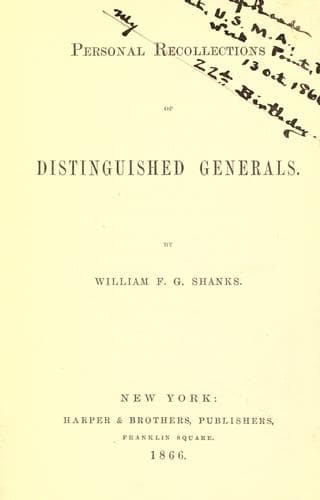
Personal Recollections of Distinguished GeneralsShanks, William Franklin Gore
History
Personal Recollections of Distinguished Generals
Shanks, William Franklin Gore
Generals -- United States; United States -- History -- Civil War, 1861-1865 -- Biography
When Howard took command of the Army of the Tennessee, an old officer
remarked that there was at last one chaplain in it. That particular
army had not paid much attention to religion, believing, like Sherman,
that crackers and meat were more necessary; and at first the men
displayed but little respect for the "intruder from the Potomac," as
much, indeed, from the fact that he came from the Potomac army as
that he was what the men called "nothing but a parson." A very short
time after taking command of this army, Howard gave orders that the
batteries of his command, then in position besieging Atlanta, should
not fire on the enemy on the Sabbath, unless it became absolutely
necessary. The enemy soon heard of this order, and generally busied
themselves on the Sabbath in casemating their guns and otherwise
strengthening their works in Howard's front, exposing themselves with
impunity, satisfied that Howard's men would keep the Sabbath holy,
though doing so under compulsion. The soldiers did not like this forced
silence, declaring that "it wasn't Grant's nor Sherman's way, nor Black
Jack's (Logan) neither;" and one of the general officers went so far
as to say that "a man who neglected his duty because it happened to
be Sunday was doubtless a Christian, but not much of a soldier." The
troops soon learned, however, that Howard was also a soldier; and when,
a year afterward, he was relieved of the command by General Logan, he
had won the love and admiration of his men.
General Howard would have liked to have been thought the representative
man of the Army of the Tennessee, but there were no points of
resemblance between him and the real representative man of that
army. The Western soldiers were of a peculiar race, and under Grant
the Army of the Tennessee, the representative army of the West, was
drilled, marched, and fought into a peculiar type of an army. Sherman
took command of it subsequently, and gave it many peculiarities, not
all of which were creditable; but neither Grant nor Sherman were its
representatives. Howard endeavored to reform the army morally and
in its discipline, which even under Grant had been bad, and under
Sherman very lax indeed, but failed to impart to it as a body any of
the qualities which shone so prominently in his character. The real
representative man of that remarkable army was General John A. Logan,
of Illinois.
[Illustration: JOHN A. LOGAN.]
Public-domain text, read in full here on John Shaqi.
Reviews
Reviews
No reviews yet
Be the first to share your thoughts on this work.
Elsewhere in the archive
Join the Discussion
Join the discussion
Sign in to leave a comment or review.
Sign InorCreate an account