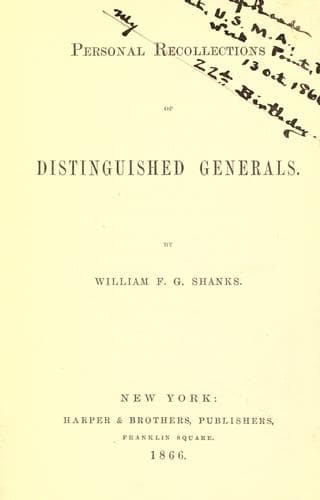
Personal Recollections of Distinguished GeneralsShanks, William Franklin Gore
History
Personal Recollections of Distinguished Generals
Shanks, William Franklin Gore
Generals -- United States; United States -- History -- Civil War, 1861-1865 -- Biography
The most remarkable of Geary's exploits was the famous "midnight
battle of Wauhatchie," a sort of companion picture to Joe Hooker's
"battle above the clouds." It took place, too, at the foot of the
mountain on which Hooker fought, and was, in a measure, preliminary
to that struggle. It was fought for position, but a position of vital
importance to both the rebels and Union forces, and consequently it
was fought for with great desperation. The movement which brought it
about was the first of those looking to the relief of the starving army
at Chattanooga, and the purpose was to occupy a position which would
cover a road by which provisions could be brought from the railroad
terminus at Bridgeport. The occupation of this position was absolutely
necessary, and Geary was fully impressed with the importance of quickly
seizing and desperately holding on to it. By the success of the
movement the route to Bridgeport would be shortened by many miles; on
its being thus shortened depended the provisioning of Chattanooga; on
this contingency depended the holding of that position, and on the
retention of that position the safety of the army and its immense and
valuable material.
Geary seized the position with great alacrity, and much to the
astonishment of the rebel Longstreet, who watched him from the summit
of Lookout Mountain. From his position on "Signal Rock"--an overarching
rock on the western side of the mountain--Longstreet had before his
eyes the whole country as on a map, and when, in the dusk of evening,
the camp-fires of Geary and Howard's troops located the positions which
Hooker had seized and was fortifying, the importance of the success
attained flashed upon Longstreet's mind in an instant, and he saw, in
the seizure of Wauhatchie by Geary, the virtual relief of the besieged
garrison of Chattanooga. He at once communicated with Bragg, and on
explaining the altered situation to that officer, the latter at once
directed Longstreet to attack Geary and Howard, and drive them back
at all hazards. Longstreet returned to his position on "Signal Rock,"
and soon had his troops in readiness to descend from their position on
the mountain, and assault Geary at Wauhatchie. From his position on
"Signal Rock" Longstreet directed the assault by signals, and to this
circumstance, singularly enough, he owed his defeat. Geary's force was
totally inadequate to contend with the superior forces of the enemy.
General Schurz, who was sent by Hooker to re-enforce him, never reached
the position, and but from the fact that Geary's signal-officers
could read the rebel signals, he must have been overwhelmed and
driven from the position. For some months previous to this battle our
signal-officers had been in possession of the rebel signal code, and
hence the flaming torches of Longstreet's signal-officers on "Signal
Rock" revealed to Geary every order given to the rebel troops advancing
against him. He was thus made aware of Longstreet's plan of attack,
Public-domain text, read in full here on John Shaqi.
Reviews
Reviews
No reviews yet
Be the first to share your thoughts on this work.
Elsewhere in the archive
Join the Discussion
Join the discussion
Sign in to leave a comment or review.
Sign InorCreate an account