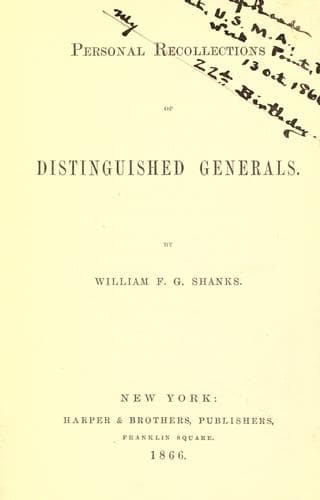
Personal Recollections of Distinguished GeneralsShanks, William Franklin Gore
History
Personal Recollections of Distinguished Generals
Shanks, William Franklin Gore
Generals -- United States; United States -- History -- Civil War, 1861-1865 -- Biography
was enabled to anticipate and meet every movement of the rebels, and,
thus forewarned, so to employ his small force by concentration in the
critical part of the field at the critical moment of attack as to
repulse every assault which was made, either by counter-charges or
rapid flank movements. After repeatedly throwing themselves against
Geary's force in vain, the rebels at length drew off discomfited.
During the whole battle the flaming torch of Longstreet flashed orders
that showed, after each repulse, his increased desperation, and
finally, much to Geary's gratification, he saw it signal the recall.
All the while the figure of Longstreet on "Signal Rock," standing out
boldly against the dark sky, was plainly visible, and, as Geary once
remarked, forcibly reminded him of a picture which he had once seen
of Satan on the mountain pointing out the riches of the world to the
Tempted, save that only the figure of the Tempter was visible.
CHAPTER VIII.
SOME PECULIARITIES OF OUR VETERANS.
Every leader of our armies has had his story written--has carved it out
with his sword, and impressed himself on the time.
But who shall write the history of our soldiers?
Who shall dare attempt to tell the story or portray the characteristics
of our veterans?
The nation, in its hour of distress, found leaders worthy to lead in
any cause. No better marshals followed the great Napoleon. We shall
leave to posterity the task of comparing our greatest general, Grant,
with Napoleon; but the present generation may be bold enough to defy
any ardent admirer of the "Little Corporal" to find among his marshals
the equal of Grant, who rather resembles in his characteristics,
and, it is said, in his features too, the conqueror of Napoleon. We
developed, indeed, counterparts for all the great generals of modern
warfare. The tenacious Thomas has the colossal proportions of mind
and body of Kleber, the clearness in danger of Massena, and, though
ponderous and unwieldy in his movements, is not more so than was
Macdonald. Halleck, like Marmont, "understands the theory of war
perfectly," and we might say of him, as Soult once said of Marmont,
and in the same sarcastic sense, that "History will tell what he did
with his knowledge." His biographer's description of Mack, wherein he
says, "Although able in the war office, he was wholly deficient in
the qualities of a commander in the field," is a perfect description
of Halleck, and adding the paragraph about Mack's popularity with the
soldiers it applies equally well to McClellan. The "first strategist of
Europe," Soult, was not one whit the superior in conception of Sherman,
and not his equal in mobility and energy. Sherman has all the vigor
and acuteness which characterized Frederick the Great, and is at heart
his equal as a military despot. Hooker has all the ardor, and Howard
all the enthusiasm of Gustavus, and were capable of as great things.
Steedman has all the roughness, nonchalance, and impudence of Suwaroff.
Public-domain text, read in full here on John Shaqi.
Reviews
Reviews
No reviews yet
Be the first to share your thoughts on this work.
Elsewhere in the archive
Join the Discussion
Join the discussion
Sign in to leave a comment or review.
Sign InorCreate an account