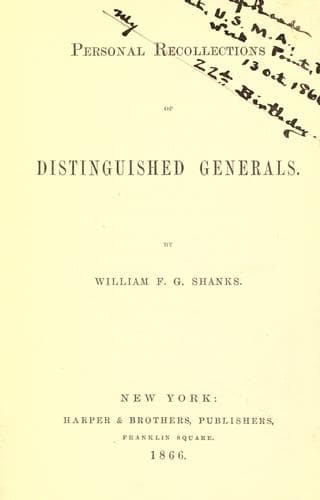
Personal Recollections of Distinguished GeneralsShanks, William Franklin Gore
History
Personal Recollections of Distinguished Generals
Shanks, William Franklin Gore
Generals -- United States; United States -- History -- Civil War, 1861-1865 -- Biography
This same difference was visible in the _personnel_ of our own and
the rebel armies, and it resulted from the same cause, and that cause
was education. The Union army was superior in prowess to that of the
South because superior in discipline, and it was superior in discipline
because superior in education. The Union army was recruited from a
people confirmed in habits of industry, and inured to hard and severe
manual and mental labor. That of the rebels was recruited from among
men reared in the comparative idleness of agricultural life, and not
habituated to severe toil, or conscripted from that hardier class of
"poor whites" whose spirits had been broken by long existence in a
state of ignorance and of slavery not less abject because indirectly
enforced and unsuspectedly endured. Neither fraction of the rebel army,
as a class, was the equal either in refinement, education, or habits of
the men of the North, nor were both combined in an army organization
equal in discipline, or the courage and effectiveness which results
from it, to that which sprang to the nation's aid in 1861. Although the
camp morality of both armies might have been better, there can be no
doubt in any unprejudiced mind that the moral sentiment of the soldiers
of the North was much more refined and correct than that of the
organized forces of the South. Not only was their discipline better,
not only were they under superior control in battle and in camp, but
when, at times, relieved of the restrictions which are thrown around
camps, their thoughts naturally turned less to dissipation and excesses
than those of the Southern soldiers. The military despotism at the
South was much more severely enforced by the rebel armies than it was
by our own, though looked upon as that of an enemy. The excesses which
at times existed in both armies were of Southern parentage. Sherman's
"bummers" were legitimate descendants of Morgan's raiders and Stuart's
cavalry, and at no time during the period in which they were "let
loose" in Georgia and South Carolina could they excel Wheeler's cavalry
in the art of plundering and destroying. The destruction of Atlanta and
Columbia by our army under Sherman occurred nearly two years after the
burning of Chambersburg by the rebels under Ewell.
Public-domain text, read in full here on John Shaqi.
Reviews
Reviews
No reviews yet
Be the first to share your thoughts on this work.
Elsewhere in the archive
Join the Discussion
Join the discussion
Sign in to leave a comment or review.
Sign InorCreate an account