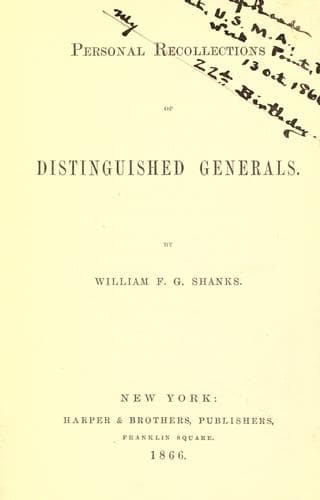
Personal Recollections of Distinguished GeneralsShanks, William Franklin Gore
History
Personal Recollections of Distinguished Generals
Shanks, William Franklin Gore
Generals -- United States; United States -- History -- Civil War, 1861-1865 -- Biography
In the same sense, and in still better defined contrast, the armies of
America and of Europe have differed in their _personnel_. The armies of
the principal powers of Europe are composed of men forced to arms by
necessity in time of peace, and conscriptions in time of war; not, like
the people of our own country, volunteering when the crisis demanded,
with a clear sense of the danger before them, and for the stern
purpose of vindicating the flag, and forcing obedience to the laws of
the country. The European soldiers are conscripted for life, become
confirmed in the habits of the camp, and are subjected to a system
of discipline which tends to the ultimate purpose of rendering them
mere pliant tools in the hands of a leader; while those of the United
States, separated from the outer world only by the lax discipline
necessary to the government of a camp, are open to every influence that
books, that letters, and, to a certain extent, that society can lend.
The highest aim of the European system is to sink individuality, and
to teach the recruit that he is but the fraction of a great machine,
to the proper working of which his perfectness in drill and discipline
is absolutely necessary. In the United States volunteer army this same
system was only partially enforced, and individuality was lost only on
the battle-field, and then only so far as was necessary to _morale_
did the man sink into the soldier. The private who in camp disagreed
and disputed with his captain on questions of politics or science was
not necessarily disobedient and demoralized on the battle-field. No
late opportunity for a comparison between the prowess of our own and
any European army has been presented, though the reader will have very
little difficulty in convincing himself that the discipline of our
troops in the South was better than that of the English in the Crimea
or the French in Italy; while the "outrages of the Northern soldiers,"
at which England murmured in her partiality for the rebels, were not
certainly as horrible as those committed by her own troops in India.
Public-domain text, read in full here on John Shaqi.
Reviews
Reviews
No reviews yet
Be the first to share your thoughts on this work.
Elsewhere in the archive
Join the Discussion
Join the discussion
Sign in to leave a comment or review.
Sign InorCreate an account