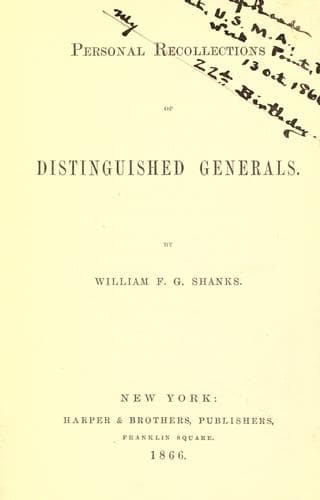
Personal Recollections of Distinguished GeneralsShanks, William Franklin Gore
History
Personal Recollections of Distinguished Generals
Shanks, William Franklin Gore
Generals -- United States; United States -- History -- Civil War, 1861-1865 -- Biography
even to traitors--and if there had been education at the South there
would have been no treason--is the right to educate himself; and since
the Constitution provides that there shall be no attainder of blood for
treason, the North owes it to the rising generation of these deceived
people to educate them into a proper appreciation of the liberty
which our veterans have won for them in defeating and conquering
their fathers. Oh, how grand and sublime would appear the record in
history that the Great Republic, after putting down the most monstrous
rebellion the world ever saw, imposed upon the conquered only the tax
for their own education, and erected no prisons save those of the
school-house and the church!
In returning to the subject of the effect of education on armies, I
have even a better illustration of the idea I have advanced than those
already given. When the war first broke out, it will be remembered
that the organization of the troops, brigades, and even divisions
were formed of regiments coming from a single state, and we were thus
rapidly falling into an error which, had it not been wisely corrected,
would have left us, at the close of the war, with an army distracted
by the same contemptible jealousies, resulting from state or sectional
pride, which were among the minor causes of the rebellion. But,
though that error was corrected by the commingling of regiments from
different states in the same brigade organization, we did commit the
error of forming two grand armies, each composed of troops exclusively
from the Eastern and Western States. The Army of the Potomac was the
representative army of the Northeastern States, being composed almost
exclusively of Eastern men. The Army of the Tennessee was composed of
men from the West, and, as it existed under General Grant, was properly
the representative army of the West. The same army was _dovetailed_
with that of the Cumberland, and placed under General Sherman, and at
the time of its dissolution was not so clearly a representative army,
Sherman having impressed his own manner on his men, and made them
a peculiar and not exactly proper type of the Western soldier. The
contrast between the men of these two armies of the East and West, in
_physique_, habits, discipline, and _morale_, was so apparent that
it is difficult to conceive that they did not belong to different
nationalities. Any comparison which would assert the superiority of
either army in endurance, courage, or fighting qualities would be
invidious and untrue, for the men of both sections fought with equal
effect and won equal honor; but it is undeniable that the Potomac
Army was by far the best disciplined army we ever had in the field.
The Potomac Army rivaled the regulars in evolutions, while Sherman's
Western boys, with their careless, free, easy gait, would outmarch a
battalion of the hardiest of the old regulars. The Potomac men did
not march as well as Sherman's troops; they had less of the elastic
Public-domain text, read in full here on John Shaqi.
Reviews
Reviews
No reviews yet
Be the first to share your thoughts on this work.
Elsewhere in the archive
Join the Discussion
Join the discussion
Sign in to leave a comment or review.
Sign InorCreate an account