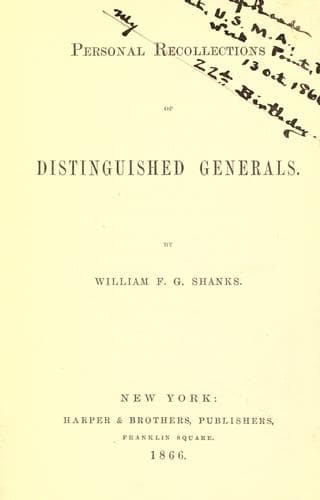
Personal Recollections of Distinguished GeneralsShanks, William Franklin Gore
History
Personal Recollections of Distinguished Generals
Shanks, William Franklin Gore
Generals -- United States; United States -- History -- Civil War, 1861-1865 -- Biography
spring of Western men, were perhaps too exact, and disposed to be too
stiff and prim, but they marched with a precision equal to the regulars
of any army. McClellan taught the Potomac Army the pure discipline
of the old regulars, and it would have required but little more of
such teaching to make them all that is expected of such troops; but
Sherman, forcible a tutor as he is, could never hope to transform
them into "bummers." General McClellan would have failed, as General
Buell did, in making regulars of the Western volunteers; and I very
much doubt if any of the old army officers who remained constantly
in the service, and who had become confirmed in the ideas of the
Academy, could have succeeded in making effectives of the Western men
in the short time that Grant and Sherman did. The success of Grant
appears to have been much influenced by his absorption, during his
long residence in the West, of the elements of the Western character,
and the toning down of the West Point precision in his education. The
same may be said of Sherman. No army of the country was under better
control, or committed fewer excesses, than the Army of the East, as the
Potomac force should have properly been called. No army committed so
many useless excesses as did that of General Sherman, and in none was
the discipline so lax, yet no army could be more implicitly trusted
in the emergencies of battle than Sherman's Army of the West. The
Potomac Army wore kid gloves off duty, and had the air of an exquisite
on parade, but this exquisite was a proficient in the warlike arts,
was always ready to fight, and did not hesitate to accept battle
with courage and confidence equal to that of its rougher ally of the
West. The Army of the West cared nothing for appearances, wore a
slouched hat and a loose blouse, and had the air of careless ease and
indifference which we often see in the pioneer. The Western veteran
had more care for his rifle than his uniform, paid more attention to
his cartridge-box than his carriage, and heartily despised drill and
parade. The Western troops lacked culture, they had less respect for
"the proprieties" than the Eastern troops, and the relations of officer
and man were maintained by them with less of the strictness that is
due to proper discipline than among Eastern troops. The Eastern men
were very particular regarding their dress, and displayed their badges
and medals with commendable pride. They devoted many hours to the
adornment of their camps, and nothing could have been more beautiful
and picturesque than many of their old camps in the Southern pine
country. The decorations were generally made with the evergreens which
abound in the South, but often mechanical contrivances operated by
the wind produced picturesque and curious effects. They indulged in
gymnastic and ball exercises to a great extent, and were very fond of
horse-racing and the higher order of games at cards. The amusements
of the Western troops were of a ruder character.
Public-domain text, read in full here on John Shaqi.
Reviews
Reviews
No reviews yet
Be the first to share your thoughts on this work.
Elsewhere in the archive
Join the Discussion
Join the discussion
Sign in to leave a comment or review.
Sign InorCreate an account