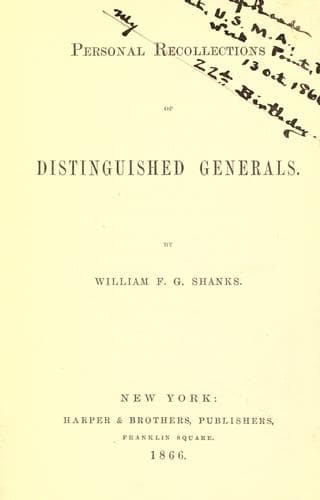
Personal Recollections of Distinguished GeneralsShanks, William Franklin Gore
History
Personal Recollections of Distinguished Generals
Shanks, William Franklin Gore
Generals -- United States; United States -- History -- Civil War, 1861-1865 -- Biography
A thorough system of discipline was necessary not only to the
organization and _morale_, but to the courage of our army, as it is of
any large body of men. Men in battle are not individually courageous.
Courage amid the horrors and under the conflicting emotions of the
battle-field is as much derived from discipline as from nature. The
fact that this war affords more numerous instances of personal heroism
displayed in battle than any other which can be recalled, does not
disprove the rule. On the contrary, it corroborates the assertion;
for if we closely inquire into the characters of those who have
distinguished themselves by heroic deeds and individual prowess, we
shall find that they have invariably been men confirmed in steady
habits, and veterans of thorough discipline. Courage is derived from
the electric touch of shoulder to shoulder of men in the line. As long
as the current is perfect, extending through the line and concentrating
in the person of the commander, whose mind directs all, and in whom
all have perfect confidence, the line can not be defeated. It may be
driven, may be broken, but the men are invincible. Break the current,
and at once the _morale_, the discipline, and the courage break with
it, and men that were a moment before invincible fly to the rear,
not overcome by fright and terror, but with the dogged, stubborn,
and gruff manner of disheartened men. A broken column in disordered
flight is one of the most wonderful studies which can be conceived.
The actuality is the very reverse of what the imagination would
conceive. "Panic-stricken men," who will "fly" fifteen and twenty miles
from a battle-field, proceed to execute that manœuvre in a manner as
systematic as if they had been taught it. They "fly"--they run from
the field--only until beyond the immediate reach of stray bullets.
The flight is disordered. The men scatter for safety apparently with
the same instinct that actuates quails to separate in rising from a
field before the hunter. When beyond the reach of the enemy's guns,
they are so scattered that it is almost impossible to rally them as
they were formerly organized, and it is next to impossible to induce
a demoralized man to fight with any other than his own regiment. When
they are beyond the reach of the enemy's guns they generally halt, look
back, and examine into matters. They will look about them, inquire
for their regiments, talk of the danger from which they have escaped,
and in a perfectly intelligible manner, until a stray bullet falling
about them gives assurance that the enemy is advancing, when, without
a word, they resume their retreat for a few hundred yards farther,
deaf alike to the threats and entreaties of any officer who does not
happen to be their immediate commander. Yet these men who are thus
broken in one battle will fight with desperate courage in the next,
and, retaining their organization, go through the engagement with
great credit.
Public-domain text, read in full here on John Shaqi.
Reviews
Reviews
No reviews yet
Be the first to share your thoughts on this work.
Elsewhere in the archive
Join the Discussion
Join the discussion
Sign in to leave a comment or review.
Sign InorCreate an account