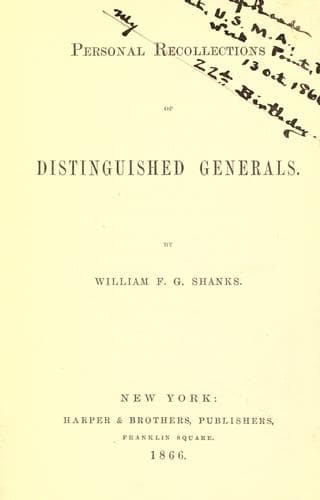
Personal Recollections of Distinguished GeneralsShanks, William Franklin Gore
History
Personal Recollections of Distinguished Generals
Shanks, William Franklin Gore
Generals -- United States; United States -- History -- Civil War, 1861-1865 -- Biography
Often circumstances, such as the former location of a
camp near the battle-field, previous positions in the reserve line,
the existence of rifle-pits, and various other localities which serve
as a rallying-point, enable broken troops to re-form and again go into
action. Men often rally on the part of an intrenched line which they
formerly held; and one of the best uses to which rifle-pits have ever
been put by offensive armies is that of forming a rallying-line when
attacking troops fail or are broken. It is a use known only to the
practice, and is not recognized by the theory of war.
Men under thorough discipline lose in a great measure their
individuality. A regiment becomes as a single man, moved by a single
impulse. The men individually are but fractions, each being able to
perform their part of the task only by the aid of the others. These
fractions are curious beings under fire. They perform deeds which
it would be morally impossible for an individual without similar
surroundings to accomplish. Thousands of our veterans will tell you
that in going into battle they have never imagined nor felt that they
were going to be shot; they have never felt as if in danger themselves,
but that their fears are for the comrades with whom they march shoulder
to shoulder. They become painfully indifferent in regard to themselves,
and appear to have none of those apprehensions with which they were
so terrified when they were raw recruits. They swear as usual, with
perhaps a little more emphasis, laugh at the comic features which
prevail under all circumstances of battle, talk freely and sensibly,
and do not betray any more, nor as much excitement as every one has
witnessed in crowds at political and other gatherings. I have seen
men in the "second line"--the reserves--playing cards while the first
were receiving a charge, and the spent shots were dropping in their
midst. While the hardest fighting was going on at Chattanooga, November
25th, 1863, I saw three soldiers sitting near the guns of Callender's
battery engaged, while under fire, in making entries in their diaries.
This is a sight seen only in the ranks of the United States armies.
During the battle of Murfreesborough, Tennessee, the rebels, in making
a charge upon General Negley's division, frightened from the fields
and woods a large number of rabbits, quails, and wild turkeys, driving
them toward the Union lines. The birds appeared too frightened to fly,
and, following the example of the rabbits, hopped and jumped over the
field, escaping from the advancing rebels. They fled, of course, toward
the rear, passing through and over our front line, and approached
the reserve troops, who, without any reference to the fact that the
rebel balls were now falling like great drops of rain among them, laid
down their guns and went to capturing wild fowls. While still engaged
in this employment, laughable even under the serious circumstances,
the first line of our troops was broken, and the rebel soldiers
Public-domain text, read in full here on John Shaqi.
Reviews
Reviews
No reviews yet
Be the first to share your thoughts on this work.
Elsewhere in the archive
Join the Discussion
Join the discussion
Sign in to leave a comment or review.
Sign InorCreate an account