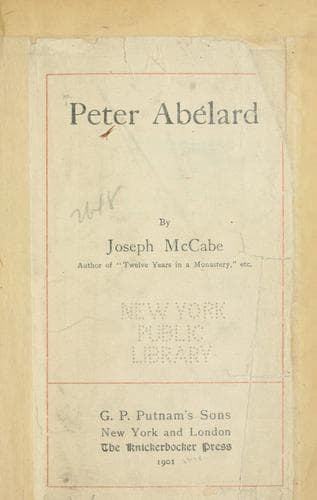
Abelard, Peter, 1079-1142; Theologians -- France -- Biography; Theology -- History -- Middle Ages, 600-1500
It opens with a calm and somewhat artificial quarrel with the
superscription of his letter, but soon breaks out into strong
reproach for his talk of death. ‘How hast thou been able to frame
such thoughts, dearest?’ she asks; ‘how hast thou found words to
convey them?’ ‘Spare me, beloved,’ she says again: ‘talk not of death
until the dread angel comes near.’ Moreover, she and her nuns would
be too distracted with grief to pray over his corpse. Seneca and
Lucan are quoted to support her. Indeed she soon lapses into words
which the theologian would call blasphemous. She turns her face to
the heavens with that old, old cry, Where is Thy boasted justice?
They were untouched in the days of their sinful joy, but smitten with
a thousand sorrows as soon as their bed had the sacramental blessing.
‘Oh, if I dared but call God cruel to me! Oh, most wretched of all
creatures that I am!’ Women have ever been the ruin of men—Adam,
Solomon, Samson, Job—she runs through the long category of man’s
sneaking accusations.
She wishes she could make satisfaction to God for her sin, but, ‘if
I must confess the true infirmity of my wretched soul, how can I
appease Him, when I am always accusing Him of the deepest cruelty
for this affliction?’ There is yet a further depth that she must
lay bare to her father confessor and her spouse. How can there be
question of penance ‘when the mind still retains the thought of
sinning, and is inflamed again with the old longing? So sweet did I
find the pleasures of our loving days, that I cannot bring myself to
reject them, nor banish them from my memory. Wheresoever I go they
thrust themselves upon my vision, and enkindle the old desire. Even
when I sleep they torment me with their fancied joy. Even during the
Mass, when our prayer should be purest, the dreadful vision of those
pleasures so haunts my soul that I am rather taken up with them than
with prayer. I ought to be lamenting what I have done; I am rather
lamenting what I miss. Not only our actions, but the places and the
times are so bound up with the thought of thee in my mind, that night
and day I am repeating all with thee in spirit. The movement of
body reveals my thoughts at times; they are betrayed in unguarded
speech. Oh, woe is me!... Not knowing my hypocrisy, people call me
“chaste.” They deem bodily integrity a virtue, whereas virtue resides
in the mind, not the body.’ Moreover, virtue should be practised out
of love for God, whereas ‘God knows that in every part of my life I
have more dread of offending thee than Him; I have a greater desire
to please thee than Him.’ Let him not deceive himself with trust in
_her_ prayers, but rather help her to overcome herself. And the poor
woman, the nobility of her soul hidden from her and crushed under the
appalling ethical ignorance and perverse ordering of her times, ends
with a plaintive hope that she may yet, in spite of all, find some
corner in heaven that will save her from the abyss.
Public-domain text, read in full here on John Shaqi.
Reviews
Reviews
No reviews yet
Be the first to share your thoughts on this work.
Elsewhere in the archive
Join the Discussion
Join the discussion
Sign in to leave a comment or review.
Sign InorCreate an account