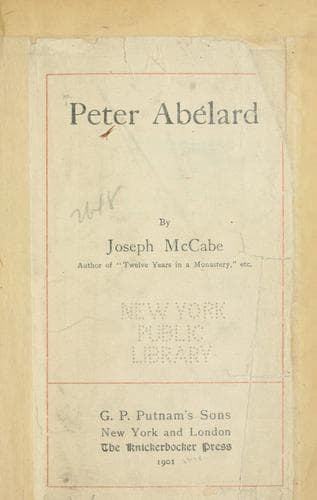
Abelard, Peter, 1079-1142; Theologians -- France -- Biography; Theology -- History -- Middle Ages, 600-1500
We have here the passages which have made Heloise an heroine in
erotic circles for so many centuries. On these words, isolated
from their context of religious horror and self-accusation,
have Bussy-Rabutin, and Pope, and the rest, erected their gaudy
structures; on them is grounded the parallel with Marianne
Alcoforado, and Rousseau’s Julie, and so many other women who have
meditated sin. Bayle has carried his Pyrrhonism so far as to doubt
that ‘bodily integrity’ which she claims for herself with so little
boasting; Chateaubriand, with broader and truer judgment, finds in
the letter the mirroring of the soul of a good woman.
There can be little doubt that the optimism of Chateaubriand has
for once come nearer to the truth than the cynicism of Bayle. The
decadent admirers of Heloise forget three circumstances which should
have diminished their equivocal adoration: the letter is from a
wife to her husband, from a penitent to her spiritual guide—women
say such things every day in the confessional, even in this very
sensitive age—from a thoughtful woman to a man whom she knew to be
dead to every breath of sensual love. There is no parallel to such a
situation.
Further, it is now obvious that the romancists have done injustice to
the soul of Heloise in their isolation of her impassioned phrases.
She objectifies her love: she is not wholly merged in it. She never
loses sight of its true position in her actual life. It is an evil,
a temptation, a torment—she would be free from it. Yet she is too
rational a thinker to turn to the easy theory of an outward tempter.
It is part of herself, a true outgrowth of the nature God has given
her; and between the voice of nature and the voice of conscience,
complicated by the influence of conventual tradition and written law,
her soul is rent with a terrific struggle. A modern confessor with a
knowledge of physiology—there are a few such—could have led her into
paths of peace without difficulty. There was no sin in her.
Public-domain text, read in full here on John Shaqi.
Reviews
Reviews
No reviews yet
Be the first to share your thoughts on this work.
Elsewhere in the archive
Join the Discussion
Join the discussion
Sign in to leave a comment or review.
Sign InorCreate an account