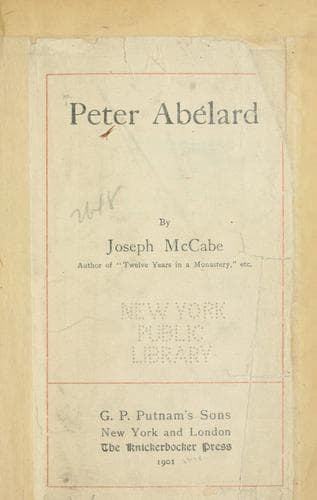
Abelard, Peter, 1079-1142; Theologians -- France -- Biography; Theology -- History -- Middle Ages, 600-1500
The first letter is addressed ‘to his most loving father and lord,
Innocent, Sovereign Pontiff by the grace of God, from Brother
Bernard, called the abbot of Clairvaux.’ From the first line he aims
at determining the case in the pope’s mind. ‘It is necessary that
there be scandals amongst us—necessary, but assuredly not welcome.’
Hence have the saints ever longed to be taken from this troubled
world. Bernard is equally tired of life. He knows not whether it
be expedient that he die, yet ‘the scandals and troubles’ about him
are pressing his departure. ‘Fool that I was to promise myself rest
if ever the Leonine trouble[33] was quelled and peace was restored
to the Church. That trouble is over, yet I have not found peace.
I had forgotten that I still lingered in the vale of tears.’ His
sorrow and his tears have been renewed. ‘We have escaped the lion
[Pierleone], only to meet the dragon [Abélard], who, in his insidious
way, is perhaps not less dangerous than the lion roaring in high
places. Did I say insidious? Would indeed that his poisoned pages did
lurk in the library, and were not read openly in the streets. His
books fly in all directions; whereas they, in their iniquity, once
shunned the light, they now emerge into it, thinking the light to be
darkness.... A new gospel is being made for the nations, a new faith
is put before them.’ After Pierleone it is useful to remind Innocent
of his second great _bête noire_. ‘The Goliath [Abélard] stalks along
in his greatness, girt about with that noble panoply of his, and
preceded by his weapon-bearer, Arnold of Brescia. Scale is joined
to scale, so closely that not a breath can get between.[34] For the
French bee [Abeille-ard] has hummed its call to the Italian bee; and
they have conspired together against the Lord and his anointed.’ He
must even deny them the merit of their notoriously ascetic lives:
‘Bearing the semblance of piety in their food and clothing, but void
of its virtue, they deceive many by transforming themselves into
angels of light—whereas they are devils.’ The pope must not be misled
by rumours of Abélard’s present fervour of life; he is ‘outwardly a
Baptist, but inwardly a Herod,’ Bernard assures him. Then follows
a passage we have already quoted. He tells the pope the edifying
story of the archbishop’s summons, his refusal, the entreaties of
his friends, the gathering of Abélard’s supporters, and his final
resolve to go: ‘Yielding to the counsel of my friends, I presented
myself at the appointed time and place, unprepared and unequipped,
save that I had in mind the monition: “Take ye no thought what and
how ye shall speak.”’ Then ‘when his books had begun to be read [he
does not say by whom], he would not listen, but went out, appealing
from the judges he had chosen. These things I tell thee in my own
defence, lest thou mayst think I have been too impetuous or bold in
the matter. But thou, O successor of Peter, thou shalt decide whether
Public-domain text, read in full here on John Shaqi.
Reviews
Reviews
No reviews yet
Be the first to share your thoughts on this work.
Elsewhere in the archive
Join the Discussion
Join the discussion
Sign in to leave a comment or review.
Sign InorCreate an account