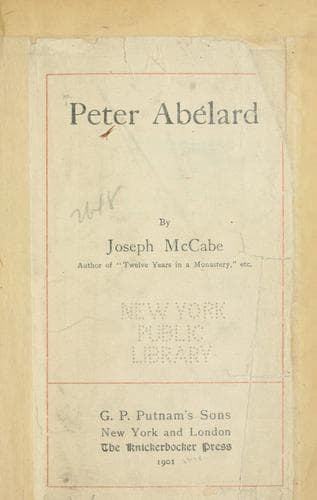
Abelard, Peter, 1079-1142; Theologians -- France -- Biography; Theology -- History -- Middle Ages, 600-1500
he who has assailed the faith of Peter should find refuge in the see
of Peter.’ In other words, do not allow Abélard to come to Rome, but
condemn him unheard, on my word. He ends with a final diplomatic
_argumentum ad invidiam_. ‘Hyacinth has done me much injury, but I
have thought well to suffer it, seeing that he did not spare you
and your court when he was at Rome, as my friend, and indeed yours,
Nicholas, will explain more fully by word of mouth.’
[33] The reference is to the anti-pope, a Pierleone. It is a
subtle reminder of what Pope Innocent owes to Bernard.
[34] Recalling some of the zoology of the Old Testament.
The second letter runs so largely on the same lines that it is
thought by some to have been sent to the pope instead of the
preceding, in which the reference to Hyacinth and the curia may have
been impolitic. ‘Weeping has the spouse of Christ wept in the night,’
it begins, ‘and tears are upon her cheeks; there is none to console
her out of all her friends. And in the delaying of the spouse, to
thee, my lord, is committed the care of the Shunammite in this land
of her pilgrimage.’ Abélard is a ‘domestic enemy,’ an Absalom, a
Judas. There is the same play upon the lion and the dragon, and upon
the scaly monster formed of Abélard and Arnold. ‘They have become
corrupt and abominable in their aims, and from the ferment of their
corruptions they pervert the faith of the simple, disturb the order
of morals, and defile the chastity of the Church.’ Moreover Abélard
‘boasts that he has opened the founts of knowledge to the cardinals
and priests of the Roman curia, and that he has lodged his books and
his opinions in the hands and hearts of the Romans; and he adduces
as patrons of his error those who should judge and condemn him.’ He
concludes with an apostrophe to Abélard, which was well calculated to
expel the last lingering doubt from the mind of the pope. ‘With what
thoughts, what conscience, canst thou have recourse to the defender
of the faith—thou, its persecutor? With what eyes, what brow, wilt
thou meet the gaze of the friend of the Spouse—thou, the violator
of His bride? Oh, if the care of the brethren did not detain me! If
bodily infirmity did not prevent it! How I should love to see the
friend of the Spouse defending the bride in His absence!’
Public-domain text, read in full here on John Shaqi.
Reviews
Reviews
No reviews yet
Be the first to share your thoughts on this work.
Elsewhere in the archive
Join the Discussion
Join the discussion
Sign in to leave a comment or review.
Sign InorCreate an account