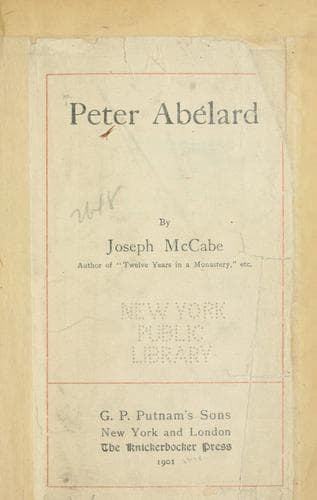
Abelard, Peter, 1079-1142; Theologians -- France -- Biography; Theology -- History -- Middle Ages, 600-1500
The third letter, a kind of preface to Bernard’s list of errors
and commentary thereon, is of the same unworthy temper, tortuous,
diplomatic, misleading, and vituperative. It is not apparent on what
ground Hausrath says this commentary represents Bernard’s speech at
Sens; if it does so, we have another curious commentary on Bernard’s
affirmation that he went to the synod unprepared. However that may
be, the letter is a singular composition, when we remember that it
accompanied an appeal to a higher court, to which the case had been
reserved. It opens with a declaration that ‘the see of Peter’ is the
due and natural tribunal to which to refer ‘all scandals that arise
in the Kingdom of God’; a declaration which is hardly consistent with
the assurance, when it is necessary to defend their condemnation of
Abélard, that his appeal ‘seems to us wonderful.’ Then follows the
familiar caricature. ‘We have here in France an old master who has
just turned theologian, who has played with the art of rhetoric from
his earliest years and now raves about the Holy Scriptures [Abélard
had been teaching Scripture and theology for the last twenty-six
years]. He is endeavouring to resuscitate doctrines that were
condemned and buried long ago, and to these he adds new errors of his
own. A man who, in his inquiries into all there is in heaven above or
earth below, is ignorant of nothing save the word “I do not know.”
He lifts his eyes to the heavens, and peers into the hidden things
of God, then returns to us with discourse of things that man is not
permitted to discuss.’ This last sentence, considered as a charge by
Bernard of Clairvaux against others, is amusing. Bernard spent half
his time in searching the hidden things of God, and the other half in
discoursing of them. But Abélard conceived them otherwise than he.
Thus was the supreme judge instructed in his part, whilst the foolish
Abélard lingered idly in Paris, not improbably, as Bernard says,
boasting of his friends at the curia. It was very possible that he
had friends at Rome. Deutsch suspects the existence of a faction in
the sacred college, which was opposed to Innocent and the Chancellor
Haymerick, and would be favourable to Abélard. Bernard was not the
man to leave a single risk unchallenged—or to the care of the Holy
Ghost.
Public-domain text, read in full here on John Shaqi.
Reviews
Reviews
No reviews yet
Be the first to share your thoughts on this work.
Elsewhere in the archive
Join the Discussion
Join the discussion
Sign in to leave a comment or review.
Sign InorCreate an account