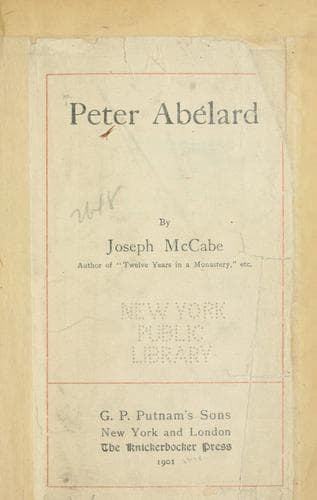
Abelard, Peter, 1079-1142; Theologians -- France -- Biography; Theology -- History -- Middle Ages, 600-1500
The basis of reconciliation with Bernard was probably a second and
shorter apology which Abélard wrote at Cluny. It was convenient to
regard this at the time as a retractation. In reality it is for the
most part a sharp rejection of Bernard’s formulation of his theses
and a new enunciation of them in more orthodox phraseology. His frame
of mind appears in the introductory note.
‘There is a familiar proverb that “Nothing is said so well that it
cannot be perverted,” and, as St. Jerome says, “He who writes many
books invites many judges.” I also have written a few things—though
little in comparison with others—and have not succeeded in escaping
censure; albeit in those things for which I am so gravely charged I
am conscious of no fault, nor should I obstinately defend it, if I
were. It may be that I have erred in my writings, but I call God to
witness and to judge in my soul that I have written nothing through
wickedness or pride of those things for which I am chiefly blamed.’
Then, warmly denying Bernard’s charge that he has ever taught a
secret doctrine, he passes to a detailed profession of faith on
the lines of Bernard’s list of errors. With regard to the Trinity
he denies all the heresies ascribed to him; this he could do with
perfect justice. On the other points he makes distinctions, adds
explanations and qualifications, and even sometimes accepts Bernard’s
thesis without remark, though one can generally see a reserve in the
background. Thus, on the question of sin committed in ignorance, he
makes the familiar modern distinction between culpable and inculpable
ignorance: he admits that we have inherited Adam’s sin, but adds
‘because his sin is the source and cause of all our sins.’ On the
question of the prevention of evil by God, he merely says, ‘Yes, He
often does’; and so forth. The only sentence which looks like a real
retractation is that in which he grants ‘the power of the keys’ to
all the clergy. In this he clearly dissociates himself from Arnold
of Brescia, and perplexes his friends. But his earlier teaching on
the point is by no means so clear and categorical as that of Arnold.
There is nothing either very commendable or very condemnable about
the document. It probably represents a grudging concession to the
abbot of Cluny’s friendly pressure and counsel to withdraw from
what was really only a heated quarrel with as little friction as
possible. That Abélard was not in the penitent mood some writers
discover in the letter is clear from the peroration. ‘My friend [!]
has concluded his list of errors with the remark: “They are found
partly in Master Peter’s book of theology, partly in his _Sentences_,
and partly in his _Scito te Ipsum_.” But I have never written a book
of _Sentences_, and therefore the remark is due to the same malice or
ignorance as the errors themselves.’
Public-domain text, read in full here on John Shaqi.
Reviews
Reviews
No reviews yet
Be the first to share your thoughts on this work.
Elsewhere in the archive
Join the Discussion
Join the discussion
Sign in to leave a comment or review.
Sign InorCreate an account