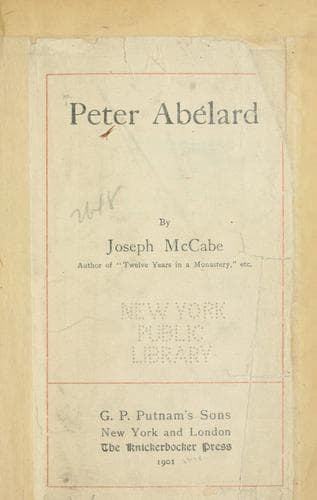
Abelard, Peter, 1079-1142; Theologians -- France -- Biography; Theology -- History -- Middle Ages, 600-1500
However, the document had a sufficient air of retractation about it
to allow Bernard to withdraw. In substance and spirit it was, as its
name indicated, an apology, not a retractation. In fact Bernard’s
zealous secretary and an unknown abbot attacked the apology, but
Abélard made no reply, and the discussion slowly died away. Bernard
had won a political triumph, and he showed a becoming willingness
to rest content with empty assurances. Abélard’s personal force was
dead; little eagerness was shown to pursue the seminal truths he had
left behind, and which were once thought so abhorrent and pernicious.
Later Benedictines virtually admit the justice of this. Mabillon
says: ‘We do not regard Abélard as a heretic; it is sufficient for
the defence of Bernard to admit that he erred in certain things.’
And the historian Noël Alexandre also says, ‘He must not be regarded
as a heretic.’ Indeed, Bernard was strongly condemned at the time
by English and German writers. Otto of Freising reproves his action
in the cases of both Abélard and Gilbert, and attributes it to
defects of character. John of Salisbury severely criticises him in
the _Historia Pontificalis_; and Walter Map, another English writer,
voices the same widespread feeling.
Another document that Abélard sent out from Cluny forms the last
page of his intercourse with Heloise. If he had wearily turned away
from the strange drama of life, his affection for her survives the
disillusion in all its force. There is a welcome tenderness in
his thought of her amidst the crushing desolation that has fallen
upon him. _She_ shall not be hurt by any unwilling impression of
persistent calumny. He writes to her a most affectionate letter,
and in the sanctuary of their love makes a solemn profession of the
purity of his faith.
‘My sister Heloise, once dear to me in the world, and now most dear
in Christ, logic has brought the enmity of men upon me. For there
are certain perverse calumniators, whose wisdom leads to perdition,
that say I take pre-eminence in logic but fail egregiously in the
interpretation of Paul; commending my ability, they would deny me the
purity of Christian faith.... I would not rank as a philosopher if it
implied any error in faith; I would not be an Aristotle if it kept me
away from Christ. For no other name is given to me under heaven in
which I may find salvation. I adore Christ, sitting at the right hand
of the Father.’ Then follows a brief confession of faith on the chief
points of Christian belief—the Trinity, the Incarnation, baptism,
penance, and the resurrection. ‘And that all anxiety and doubt may be
excluded from thy heart,’ he concludes, ‘do thou hold this concerning
me, I have grounded my conscience on that rock on which Christ has
built His Church.’
Public-domain text, read in full here on John Shaqi.
Reviews
Reviews
No reviews yet
Be the first to share your thoughts on this work.
Elsewhere in the archive
Join the Discussion
Join the discussion
Sign in to leave a comment or review.
Sign InorCreate an account