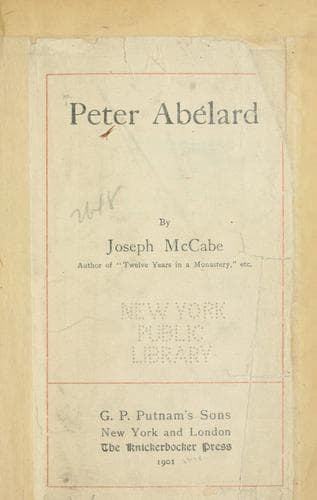
Abelard, Peter, 1079-1142; Theologians -- France -- Biography; Theology -- History -- Middle Ages, 600-1500
Here we have a much more difficult problem to deal with. It may at
once be frankly avowed that there is little evidence of a direct
transition of Abélard’s ideas into the accepted scheme of theology.
Some of the most careful and patient biographers of Abélard, as a
theologian, say that we cannot claim for him any direct influence on
the course of theological development. Deutsch points out that his
works must have become rare, and the few copies secretly preserved,
after their condemnation by the pope; certainly few manuscripts of
them have survived. He had formed no theological school (as distinct
from philosophical), or the beginning of one must have been crushed
at Sens. His Roman pupils and admirers were probably not men who
would cultivate loyalty under unfavourable circumstances. The
schoolmen of the following century only know Abélard from passages in
Hugh of St. Victor and others of his enemies. The first to reproduce
what Deutsch takes to be the characteristic spirit or method of
Abélard is Roger Bacon; it is extremely doubtful if he had any
acquaintance whatever with Abélard. The world was prepared to receive
the ideas of Abélard with some respect in the thirteenth century, but
it had then a task which was too absorbing to allow a search for the
manuscripts of ‘a certain Abélard,’ as one later theologian put it.
The Arabians and Jews had reintroduced Aristotle into Europe. He had
come to stay; and the schoolmen were engrossed in the work of fitting
him with garments of Christian theology.
On the other hand there are historians, such as Reuter, who grant
Abélard a large measure of direct influence on the development of
theology. It is pointed out that a very large proportion of the
masters of the next generation had studied under Abélard. Reuter
instances Bernard Sylvester of Chartres and William of Conches, as
well as Gilbert de la Porée. Clearer instances of direct influence
are found in the case of Master Roland of Bologna (afterwards to
ascend the papal throne under the name of Alexander III.) and Master
Omnebene of the same city. It is, in any case, quite clear that
Abélard was pre-eminently a teacher of teachers. On the other hand
it would be incorrect to lay too much stress on the condemnation by
Pope Innocent. All the world knew that Bernard had prudently kept
the unexecuted Bull in his pocket, and that Abélard was teaching
theology at Cluny, with the pope’s approval, a few months after the
condemnation.
Public-domain text, read in full here on John Shaqi.
Reviews
Reviews
No reviews yet
Be the first to share your thoughts on this work.
Elsewhere in the archive
Join the Discussion
Join the discussion
Sign in to leave a comment or review.
Sign InorCreate an account