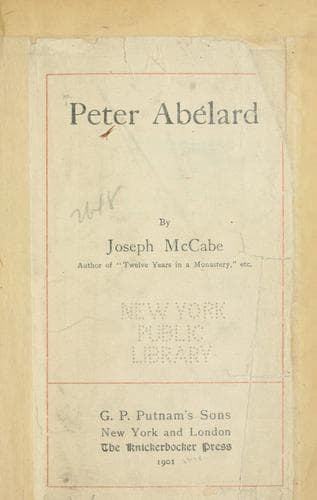
Abelard, Peter, 1079-1142; Theologians -- France -- Biography; Theology -- History -- Middle Ages, 600-1500
It is best to distinguish once more between the spirit or method of
Abélard and his particular critical conclusions. His conclusions,
his suggestions for the reconstruction of certain dogmas, were
lost to theological science. The cruder notions of the earlier
age and of Bernard continued to be regarded as _the_ truth for
many centuries. Even the masters, such as Roland of Bologna, who
did found their theology more conspicuously on that of Abélard,
prudently deviated from his opinions where they were ‘offensive to
pious ears.’ His treatment of the Trinity is, perhaps, an exception.
Not that Abélard’s favourite analogies—that of the seal and its
impression, and so forth—were retained, but he had set an example
in the rationalistic or naturalistic illustration of the mystery
which persisted in the schools. All the great schoolmen of the
following century accepted the Abélardist notion of a rationalistic
illustration and defence of the Trinity. They constructed an
elaborately meaningless analogy of it, and invented a ‘virtual’
distinction—a mental distinction which might be taken to be objective
for apologetic purposes—between the essence and the personalities.
But Abélard’s penetrating and reconstructive criticisms of the
current dogmas of original sin, the Incarnation, responsibility,
reward and punishment, inspiration, omnipotence, etc., degenerated
into, at the most, obscure heresies—sank back into the well of truth
until long after a rebellious monk had broken the bonds which held
the intellect of Europe.
Public-domain text, read in full here on John Shaqi.
Reviews
Reviews
No reviews yet
Be the first to share your thoughts on this work.
Elsewhere in the archive
Join the Discussion
Join the discussion
Sign in to leave a comment or review.
Sign InorCreate an account