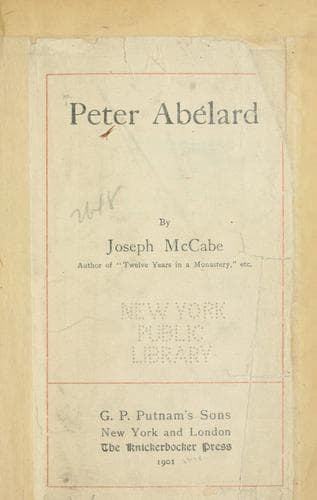
Abelard, Peter, 1079-1142; Theologians -- France -- Biography; Theology -- History -- Middle Ages, 600-1500
It is equally difficult and more interesting to determine how far
Abélard himself was created by predecessors. Nowadays no thought is
revolutionary; but some notions are more rapid in their evolution
than others. To what extent Abélard’s ideas were thus borrowed
from previous thinkers it is not easy to determine with precision.
He was far from being the first rationalist of the Middle Ages.
Scotus Erigena and Bérenger (of anti-sacramental fame) were well
remembered in his day. He himself studied under a rationalistic
master—Jean Roscelin, canon of Compiègne,—in his early years. We do
not know with certainty at what age he studied under Roscelin, and
cannot, therefore, determine how great an influence the older master
exercised over him. But there can be little doubt that Abélard must
be credited with a very large force of original genius. At the most,
the attitude of his mind towards dogma was determined by outward
influences, concurring with his own temperament and character
of mind. It is more than probable that this attitude would have
been adopted by him even had there been no predisposing influence
whatever. His rationalism flows spontaneously and irresistibly from
his type of mind and character. In the development of the rationalist
principle we see the exclusive action of his own intelligence.
To most of us in this generation such dogmatic reconstruction as
Abélard urged seems obvious enough; yet one needs little imagination
to appreciate the mental power or, rather, penetration, which was
necessary to realise its necessity in the twelfth century.
One is tempted at times to speculate on the probable development of
Abélard’s thoughts if that great shadow had not fallen on his life
at so early a period. There are two Abélards. The older theologian,
who is ever watchful to arrest his thoughts when they approach
clear, fundamental dogmas, is not the natural development of the
freethinking author of the _Sic et Non_. With the conversion to the
ascetic ideal had come a greater awe in approaching truths which
were implicitly accepted as divine. Yet we may well doubt if Abélard
would ever have advanced much beyond his actual limits. Starting
from the world of ideas in which he lived, he would have needed an
exceptional strength to proceed to any very defiant and revolutionary
conclusions. He was not of the stuff of martyrs, of Scotus Erigena,
or Arnold of Brescia. He had no particle of the political ability of
Luther. But such as he is, gifted with a penetrating mind, and led by
a humanist ideal that touched few of his contemporaries, pathetically
irresolute and failing because the fates had made him the hero of
a great drama and ironically denied him the hero’s strength, he
deserves at least to be drawn forth from the too deep shadow of a
crude and unsympathetic tradition.
INDEX
Abélard, origin of name, 11.
Aboilar, 11.
Adam, Abbot of St. Denis, 126, 129, 134, 154, 168, 170, 174, 175.
Adam of the Little Bridge, 38.
Public-domain text, read in full here on John Shaqi.
Reviews
Reviews
No reviews yet
Be the first to share your thoughts on this work.
Elsewhere in the archive
Join the Discussion
Join the discussion
Sign in to leave a comment or review.
Sign InorCreate an account