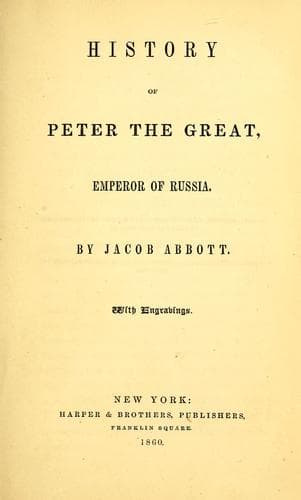
Peter I, Emperor of Russia, 1672-1725; Russia -- History -- Peter I, 1689-1725
But, while the Czar was thus rapidly increasing his power at sea, the
King of Sweden proved himself the strongest on land. He extended his
conquests very rapidly in Poland and in the adjoining provinces, and at
last, in the summer of 1708, he conceived the design of crossing the
Dnieper and threatening Moscow, which was still Peter's capital. He
accordingly pushed his forces forward until he approached the bank of
the river. He came up to it at a certain point, as if he was intending
to cross there. Peter assembled all his troops on the opposite side of
the river at that point in order to oppose him. But the demonstration
which the king made of an intention to cross at that point was only a
pretense. He left a sufficient number of men there to make a show, and
secretly marched away the great body of his troops in the night to a
point about three miles farther up the river, where he succeeded in
crossing with them before the emperor's forces had any suspicion of his
real design. The Russians, who were not strong enough to oppose him in
the open field, were obliged immediately to retreat, and leave him in
full possession of the ground.
Peter was now much alarmed. He sent an officer to the camp of the King
of Sweden with a flag of truce, to ask on what terms the king would
make peace with him. But Charles was too much elated with his success
in crossing the river, and placing himself in a position from which he
could advance, without encountering any farther obstruction, to the
very gates of the capital, to be willing then to propose any terms. So
he declined entering into any negotiation, saying only in a haughty
tone "that he would treat with his brother Peter at Moscow."
On mature reflection, however, he seems to have concluded that it would
be more prudent for him not to march at once to Moscow, and so he
turned his course for a time toward the southward, in the direction of
the Crimea and the Black Sea.
There was one secret reason which induced the King of Sweden to move
thus to the southward which Peter did not for a time understand. The
country of the Cossacks lay in that direction, and the famous Mazeppa,
of whom some account has already been given in this volume, was the
chieftain of the Cossacks, and he, as it happened, had had a quarrel
with the Czar, and in consequence of it had opened a secret negotiation
with the King of Sweden, and had agreed that if the king would come
into his part of the country he would desert the cause of the Czar, and
would come over to his side, with all the Cossacks under his command.
Public-domain text, read in full here on John Shaqi.
Reviews
Reviews
No reviews yet
Be the first to share your thoughts on this work.
Elsewhere in the archive
Join the Discussion
Join the discussion
Sign in to leave a comment or review.
Sign InorCreate an account