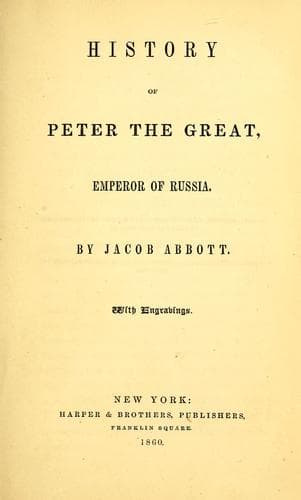
Peter I, Emperor of Russia, 1672-1725; Russia -- History -- Peter I, 1689-1725
The cause of Mazeppa's quarrel with the Czar was this: He was one day
paying a visit to his majesty, and, while seated at table, Peter began
to complain of the lawless and ungovernable character of the Cossacks,
and to propose that Mazeppa should introduce certain reforms in the
organization and discipline of the tribe, with a view of bringing them
under more effectual control. It is probable that the reforms which he
proposed were somewhat analogous to those which he had introduced so
successfully into the armies under his own more immediate command.
Mazeppa opposed this suggestion. He said that the attempt to adopt
such measures with the Cossacks would never succeed; that the men were
so wild and savage by nature, and so fixed in the rude and irregular
habits of warfare to which they and their fathers had been so long
accustomed, that they could never be made to submit to such
restrictions as a regular military discipline would impose.
Peter, who never could endure the least opposition or contradiction to
any of his ideas or plans, became quite angry with Mazeppa on account
of the objections which he made to his proposals, and, as was usual
with him in such cases, he broke out in the most rude and violent
language imaginable. He called Mazeppa an enemy and a traitor, and
threatened to have him impaled alive. It is true he did not really
mean what he said, his words being only empty threats dictated by the
brutal violence of his anger. Still, Mazeppa was very much offended.
He went away from the Czar's tent muttering his displeasure, and
resolving secretly on revenge.
Soon after this Mazeppa opened the communication above referred to with
the King of Sweden, and at last an agreement was made between them by
which it was stipulated that the king was to advance into the southern
part of the country, where, of course, the Cossacks would be sent out
to meet him, and then Mazeppa was to revolt from the Czar, and go over
with all his forces to the King of Sweden's side. By this means the
Czar's army was sure, they thought, to be defeated; and in this case
the King of Sweden was to remain in possession of the Russian
territory, while the Cossacks were to retire to their own fortresses,
and live thenceforth as an independent tribe.
Public-domain text, read in full here on John Shaqi.
Reviews
Reviews
No reviews yet
Be the first to share your thoughts on this work.
Elsewhere in the archive
Join the Discussion
Join the discussion
Sign in to leave a comment or review.
Sign InorCreate an account