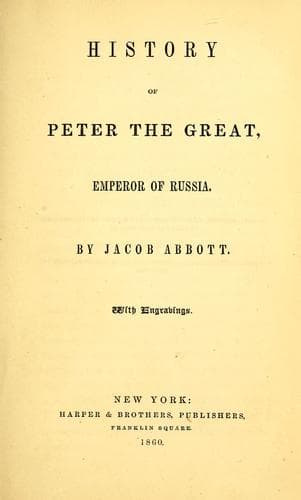
Peter I, Emperor of Russia, 1672-1725; Russia -- History -- Peter I, 1689-1725
The examination was protracted through many months. The result of it,
on the whole, was, that it was fully proved that there was a powerful
party in Russia opposed to the reforms and improvements of the Czar,
and particularly to the introduction of the European civilization into
the country, who were desirous of effecting a revolution, and who
wished to avail themselves of the quarrel between Alexis and his father
to promote their schemes. Alexis was too much stupefied by his
continual drunkenness to take any very active or intelligent part in
these schemes, but he was more or less distinctly aware of them; and in
the offers which he had made to enter a monastery and renounce all
claims to the crown he had been utterly insincere, his only object
having been to blind his father by means of them and gain time. He
acknowledged that he had hated his father, and had wished for his
death, and when he fled to Vienna it was his intention to remain until
he could return and take possession of the empire in his father's
place. He, however, solemnly declared that it was never his intention
to take any steps himself toward that end during his father's lifetime,
though he admitted, at last, when the fact had been pretty well proved
against him by other evidence, that, in case an insurrection in his
behalf had broken out in Russia, and he had been called upon, he should
have joined the rebels.
A great deal of information, throwing light upon the plans of Alexis
and of the conspirators in Russia connected with him, was obtained from
the disclosures made by Afrosinia. As has already been stated, she had
been taken by Alexis as a slave, and forced, against her will, to join
herself to him and to follow his fortunes. He had never admitted her
into his confidence, but had induced her, from time to time, to act as
he desired by telling her any falsehood which would serve the purpose.
She consequently was not bound to him by any ties of honor or
affection, and felt herself at liberty to answer freely all questions
which were put to her by the judges. Her testimony was of great value
in many points, and contributed very essentially toward elucidating the
whole affair.
CHAPTER XVIII.
THE CONDEMNATION AND DEATH OF ALEXIS.
1718
Public-domain text, read in full here on John Shaqi.
Reviews
Reviews
No reviews yet
Be the first to share your thoughts on this work.
Elsewhere in the archive
Join the Discussion
Join the discussion
Sign in to leave a comment or review.
Sign InorCreate an account