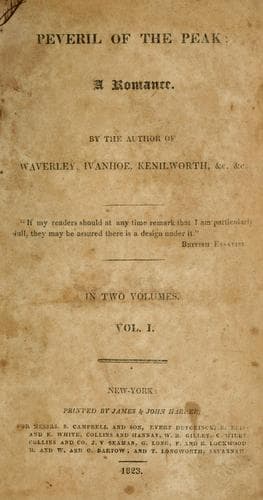
Great Britain -- History -- Charles II, 1660-1685 -- Fiction
After brief reflection, therefore, he resolved to endure the encumbrance
of the stranger’s society, until a fair opportunity should occur to rid
himself of it; and, in the meantime, to act with as much caution as he
possibly could, in any communication that might take place between them;
for Dame Whitecraft’s parting caution still rang anxiously in his ears,
and the consequences of his own arrest upon suspicion, must deprive him
of every opportunity of serving his father, or the countess, or Major
Bridgenorth, upon whose interest, also, he had promised himself to keep
an eye.
While he revolved these things in his mind, they had journeyed several
miles without speaking; and now entered upon a more waste country, and
worse roads, than they had hitherto found, being, in fact, approaching
the more hilly district of Derbyshire. In travelling on a very stony and
uneven lane, Julian’s horse repeatedly stumbled; and, had he not been
supported by the rider’s judicious use of the bridle, must at length
certainly have fallen under him.
“These are times which crave wary riding, sir,” said his companion;
“and by your seat in the saddle, and your hand on the rein, you seem to
understand it to be so.”
“I have been long a horseman, sir,” answered Peveril.
“And long a traveller, too, sir, I should suppose; since by the great
caution you observe, you seem to think the human tongue requires a curb,
as well as the horse’s jaws.”
“Wiser men than I have been of opinion,” answered Peveril, “that it
were a part of prudence to be silent, when men have little or nothing to
say.”
“I cannot approve of their opinion,” answered the stranger. “All
knowledge is gained by communication, either with the dead, through
books, or, more pleasingly, through the conversation of the living. The
_deaf and dumb_, alone, are excluded from improvement; and surely their
situation is not so enviable that we should imitate them.”
At this illustration, which awakened a startling echo in Peveril’s
bosom, the young man looked hard at his companion; but in the composed
countenance, and calm blue eye, he read no consciousness of a farther
meaning than the words immediately and directly implied. He paused a
moment, and then answered, “You seem to be a person, sir, of shrewd
apprehension; and I should have thought it might have occurred to you,
that in the present suspicious times, men may, without censure, avoid
communication with strangers. You know not me; and to me you are totally
unknown. There is not room for much discourse between us, without
trespassing on the general topics of the day, which carry in them seeds
of quarrel between friends, much more betwixt strangers. At any other
time, the society of an intelligent companion would have been most
acceptable upon my solitary ride; but at present----”
Public-domain text, read in full here on John Shaqi.
Reviews
Reviews
No reviews yet
Be the first to share your thoughts on this work.
Elsewhere in the archive
Join the Discussion
Join the discussion
Sign in to leave a comment or review.
Sign InorCreate an account