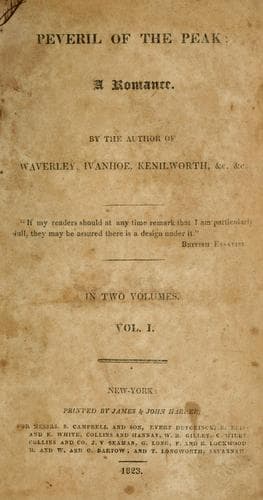
Great Britain -- History -- Charles II, 1660-1685 -- Fiction
Julian Peveril, amongst others of the _dramatis personæ_, had arrived,
and taken up his abode in a remote inn in the suburbs. His business, he
conceived, was to remain incognito until he should have communicated in
private with the friends who were most likely to lend assistance to
his parents, as well as to his patroness, in their present situation
of doubt and danger. Amongst these, the most powerful was the Duke of
Ormond, whose faithful services, high rank, and acknowledged worth and
virtue, still preserved an ascendancy in that very Court, where, in
general, he was regarded as out of favour. Indeed, so much consciousness
did Charles display in his demeanour towards that celebrated noble, and
servant of his father, that Buckingham once took the freedom to ask the
King whether the Duke of Ormond had lost his Majesty’s favour, or his
Majesty the Duke’s? since, whenever they chanced to meet, the King
appeared the more embarrassed of the two. But it was not Peveril’s
good fortune to obtain the advice or countenance of this distinguished
person. His Grace of Ormond was not at that time in London.
The letter, about the delivery of which the Countess had seemed most
anxious after that to the Duke of Ormond, was addressed to Captain
Barstow (a Jesuit, whose real name was Fenwicke), to be found, or at
least to be heard of, in the house of one Martin Christal in the Savoy.
To this place hastened Peveril, upon learning the absence of the Duke of
Ormond. He was not ignorant of the danger which he personally incurred,
by thus becoming a medium of communication betwixt a Popish priest and a
suspected Catholic. But when he undertook the perilous commission of his
patroness, he had done so frankly, and with the unreserved resolution
of serving her in the manner in which she most desired her affairs to
be conducted. Yet he could not forbear some secret apprehension, when he
felt himself engaged in the labyrinth of passages and galleries, which
led to different obscure sets of apartments in the ancient building
termed the Savoy.
This antiquated and almost ruinous pile occupied a part of the site of
the public offices in the Strand, commonly called Somerset House. The
Savoy had been formerly a palace, and took its name from an Earl of
Savoy, by whom it was founded. It had been the habitation of John of
Gaunt, and various persons of distinction--had become a convent, an
hospital, and finally, in Charles II.’s time, a waste of dilapidated
buildings and ruinous apartments, inhabited chiefly by those who had
some connection with, or dependence upon, the neighbouring palace of
Somerset House, which, more fortunate than the Savoy, had still
retained its royal title, and was the abode of a part of the Court, and
occasionally of the King himself, who had apartments there.
Public-domain text, read in full here on John Shaqi.
Reviews
Reviews
No reviews yet
Be the first to share your thoughts on this work.
Elsewhere in the archive
Join the Discussion
Join the discussion
Sign in to leave a comment or review.
Sign InorCreate an account