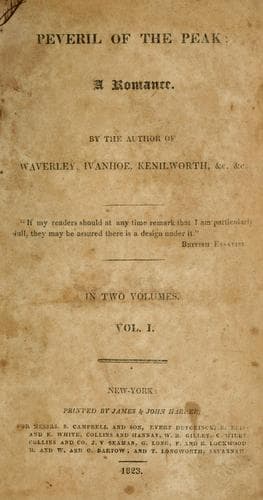
Great Britain -- History -- Charles II, 1660-1685 -- Fiction
It was not without several inquiries, and more than one mistake, that,
at the end of a long and dusky passage, composed of boards so wasted by
time that they threatened to give way under his feet, Julian at
length found the name of Martin Christal, broker and appraiser, upon a
shattered door. He was about to knock, when some one pulled his cloak;
and looking round, to his great astonishment, which indeed almost
amounted to fear, he saw the little mute damsel, who had accompanied him
for a part of the way on his voyage from the Isle of Man.
“Fenella!” he exclaimed, forgetting that she could neither hear nor
reply,--“Fenella! Can this be you?”
Fenella, assuming the air of warning and authority, which she had
heretofore endeavoured to adopt towards him, interposed betwixt Julian
and the door at which he was about to knock--pointed with her finger
towards it in a prohibiting manner, and at the same time bent her brows,
and shook her head sternly.
After a moment’s consideration, Julian could place but one
interpretation upon Fenella’s appearance and conduct, and that was, by
supposing her lady had come up to London, and had despatched this mute
attendant, as a confidential person, to apprise him of some change of
her intended operations, which might render the delivery of her letters
to Barstow, _alias_ Fenwicke, superfluous, or perhaps dangerous. He made
signs to Fenella, demanding to know whether she had any commission from
the Countess. She nodded. “Had she any letter?” he continued, by the
same mode of inquiry. She shook her head impatiently, and, walking
hastily along the passage, made a signal to him to follow. He did
so, having little doubt that he was about to be conducted into the
Countess’s presence; but his surprise, at first excited by Fenella’s
appearance, was increased by the rapidity and ease with which she seemed
to track the dusky and decayed mazes of the dilapidated Savoy, equal to
that with which he had seen her formerly lead the way through the gloomy
vaults of Castle Rushin, in the Isle of Man.
When he recollected, however, that Fenella had accompanied the Countess
on a long visit to London, it appeared not improbable that she might
then have acquired this local knowledge which seemed so accurate. Many
foreigners, dependent on Queen or Queen Dowager, had apartments in the
Savoy. Many Catholic priests also found refuge in its recesses, under
various disguises, and in defiance of the severity of the laws against
Popery. What was more likely than that the Countess of Derby, a Catholic
and a Frenchwoman, should have had secret commissions amongst such
people; and that the execution of such should be entrusted, at least
occasionally, to Fenella?
Thus reflecting, Julian continued to follow her light and active
footsteps as she glided from the Strand to Spring-Garden, and thence
into the Park.
Public-domain text, read in full here on John Shaqi.
Reviews
Reviews
No reviews yet
Be the first to share your thoughts on this work.
Elsewhere in the archive
Join the Discussion
Join the discussion
Sign in to leave a comment or review.
Sign InorCreate an account