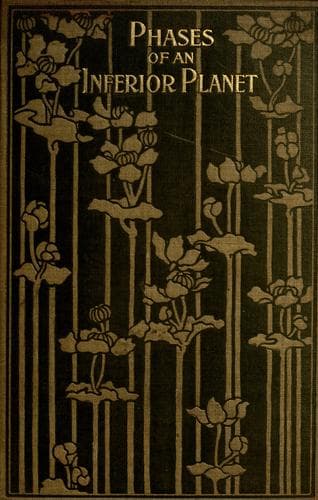
Phases of an Inferior PlanetGlasgow, Ellen Anderson Gholson
General
Phases of an Inferior Planet
Glasgow, Ellen Anderson Gholson
Fiction
"I should like some water, please," she said, and as Agnes went into the
dining-room she looked about the luxurious study with passionate eyes.
It was so different from the one at The Gotham, that comfortless square
of uncarpeted floor, with the pine book-shelves and the skull and
cross-bones above the mantel.
The desk, with its hand-carving of old mahogany, recalled to her the one
that he had used when she had first known him, with its green baize
cover splotched with ink.
The swing of the rich curtains, the warmth of the Turkish rugs, the
portraits in their massive frames, jarred her vibrant emotions. How
could he pass from this to the farm in the South--to the old, old fight
with poverty and the drama of self-denial? Would she not fail him again,
as she had failed him once before? Would she not shatter his happiness
in a second chance, as she had shattered it in the first?
The tears sprang to her eyes and scorched her lids. She rose hastily
from her chair.
When the servant returned with the glass of water she drank a few
swallows. "Thank you," she said, gently. "I will go now. Perhaps I will
come again to-morrow."
She passed to the sidewalk and turned in the direction of the church,
walking rapidly. She had not thought of his being at church. Indeed,
until entering his study she had forgotten the office he held. She had
remembered only that he loved her.
As she neared the building an impulse seized her to turn and go back--to
wait for him at the rectory. The sound of the intoning of the gospel
came to her like a lament. She felt suddenly afraid.
Then several persons brushed her in passing, and she entered the heavy
doors, which closed behind her with a dull thud.
After the grayness of the day without, the warmth and color of the
interior were as vivid as a revelation. They enveloped her like the
perfumed air of a hot-house, heavy with the breath of rare
exotics--exotics that had flowered amid the ardent glooms of mediaevalism
and the colorific visions of cloistered emotions. Entering a pew in the
side-aisle, she leaned her head against a stone pillar and closed her
eyes in sudden restfulness. That emotional, religious instinct which had
always been a part of her artistic temperament was quickened in
intensity. She felt a desire to worship--something--anything.
When she raised her lids the colors seemed to have settled into
harmonious half-tones. The altar, which had at first showed blurred
before her eyes, dawned through the rising clouds of incense. She saw
the white of the altar-cloth, and the flaming candles, shivering from a
slight draught, and above the crucifix the Christ in his purple robes,
smiling his changeless smile.
Within the chancel, through the carving of the rood-screen, she saw the
flutter of the white gowns of the choristers, and here and there the
fair locks of a child.
Then the priest came to the middle of the altar, his figure softened by
circles of incense, the sanctuary lamp burning above his head.
Public-domain text, read in full here on John Shaqi.
Reviews
Reviews
No reviews yet
Be the first to share your thoughts on this work.
Elsewhere in the archive
Join the Discussion
Join the discussion
Sign in to leave a comment or review.
Sign InorCreate an account