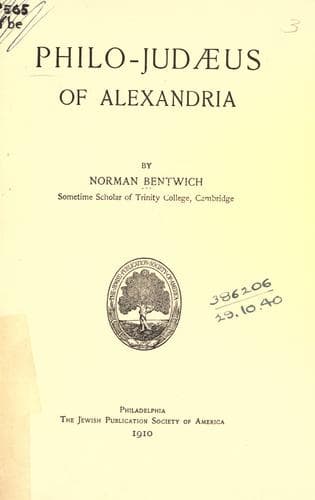
To these various books I owe much, but not so much as to the teaching,
influence, and help of one whose name I have not the boldness to
associate with this little volume, but whose notes on my manuscript
have given it whatever value it may possess. The index I owe to the
kindly help of a sister, who would also be nameless. Lastly I have to
thank Dr. Lionel Barnett, professor of Sanscrit at University College,
London, and my father, who read my manuscript before it was sent to
the printers. The one gave me the benefit of his wide and accurate
scholarship, the other gave me much valuable advice and removed many a
blazing indiscretion.
NORMAN BENTWICH.
_February 28, 1907._
CONTENTS
PAGE
I. THE JEWISH COMMUNITY AT ALEXANDRIA
II. THE LIFE AND TIMES OF PHILO
III. PHILO'S WORKS AND METHOD
IV. PHILO AND THE TORAH
V. PHILO'S THEOLOGY
VI. PHILO AS A PHILOSOPHER
VII. PHILO AND JEWISH TRADITION
VIII. THE INFLUENCE OF PHILO
BIBLIOGRAPHY
ABBREVIATIONS USED FOR THE REFERENCES
INDEX
PHILO-JUDÆUS OF ALEXANDRIA
I
THE JEWISH COMMUNITY AT ALEXANDRIA
The three great world-conquerors known to history, Alexander, Julius
Cæsar, and Napoleon, recognized the pre-eminent value of the Jew as a
bond of empire, an intermediary between the heterogeneous nations
which they brought beneath their sway. Each in turn showed favor to
his religion, and accorded him political privileges. The petty tyrants
of all ages have persecuted Jews on the plea of securing uniformity
among their subjects; but the great conqueror-statesmen who have made
history, realizing that progress is brought about by unity in
difference, have recognized in Jewish individuality a force making for
progress. Whereas the pure Hellenes had put all the other peoples of
the world in the single category of barbarians, their Macedonian
conqueror forced upon them a broader view, and, regarding his empire
as a world-state, made Greeks and Orientals live together, and
prepared the way for a mingling of races and culture. Alexander the
Great became a notable figure in the Talmud and Midrashim, and many a
marvellous legend was told about his passing visit to Jerusalem during
his march to Egypt.[1] The high priest--whether it was Jaddua, Simon,
or Onias the records do not make clear--is said to have gone out to
meet him, and to have compelled the reverence and homage of the
monarch by the majesty of his presence and the lustre of his robes. Be
this as it may, it is certain that Alexander settled a considerable
number of Jews in the Greek colonies which he founded as centres of
cosmopolitan culture in his empire, and especially in the town by the
mouth of the Nile that received his own name, and was destined to
become within two centuries the second town in the world; second only
to Rome in population and power, equal to it in culture. By its
geographical position, the nature of its foundation, and the sources
Public-domain text, read in full here on John Shaqi.
Reviews
Reviews
No reviews yet
Be the first to share your thoughts on this work.
Join the Discussion
Join the discussion
Sign in to leave a comment or review.
Sign InorCreate an account