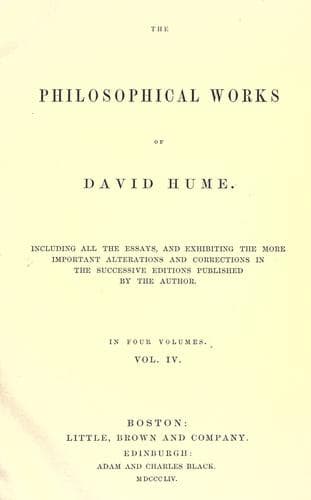
Philosophical Works, v. 1 (of 4): Including All the Essays, and Exhibiting the More Important Alterations and Corrections in the Successive Editions Published by the AuthorHume, David
PhilosophyPhilosophy
Philosophical Works, v. 1 (of 4): Including All the Essays, and Exhibiting the More Important Alterations and Corrections in the Successive Editions Published by the Author
Hume, David
Knowledge, Theory of; Philosophy, English -- 18th century
I may subjoin another argument proposed by a noted author,[2] which
seems to me very strong and beautiful. 'Tis evident, that existence
in itself belongs only to unity, and is never applicable to number,
but on account of the unites of which the number is composed. Twenty
men may be said to exist; but 'tis only because one, two, three, four,
&c. are existent; and if you deny the existence of the latter, that of
the former falls of course. 'Tis therefore utterly absurd to suppose
any number to exist, and yet deny the existence of unites; and as
extension is always a number, according to the common sentiment of
metaphysicians, and never resolves itself into any unite or indivisible
quantity, it follows that extension can never at all exist. 'Tis in
vain to reply, that any determinate quantity of extension is an unite;
but such a one as admits of an infinite number of fractions, and is
inexhaustible in its subdivisions. For by the same rule, these twenty
men _may be considered as an unite_. The whole globe of the earth, nay,
the whole universe _may be considered as an unite_. That term of unity
is merely a fictitious denomination, which the mind may apply to any
quantity of objects it collects together; nor can such an unity any
more exist alone than number can, as being in reality a true number.
But the unity, which can exist alone, and whose existence is necessary
to that of all number, is of another kind, and must be perfectly
indivisible, and incapable of being resolved into any lesser unity.
All this reasoning takes place with regard to time; along with an
additional argument, which it may be proper to take notice of. 'Tis
a property inseparable from time, and which in a manner constitutes
its essence, that each of its parts succeeds another, and that none
of them, however contiguous, can ever be co-existent. For the same
reason that the year 1737 cannot concur with the present year 1738,
every moment must be distinct from, and posterior or antecedent to
another. 'Tis certain then, that time, as it exists, must be composed
of indivisible moments. For if in time we could never arrive at an
end of division, and if each moment, as it succeeds another, were not
perfectly single and indivisible, there would be an infinite number of
co-existent moments, or parts of time; which I believe will be allowed
to be an arrant contradiction.
The infinite divisibility of space implies that of time, as is evident
from the nature of motion. If the latter, therefore, be impossible, the
former must be equally so.
Public-domain text, read in full here on John Shaqi.
Reviews
Reviews
No reviews yet
Be the first to share your thoughts on this work.
Elsewhere in the archive
Join the Discussion
Join the discussion
Sign in to leave a comment or review.
Sign InorCreate an account