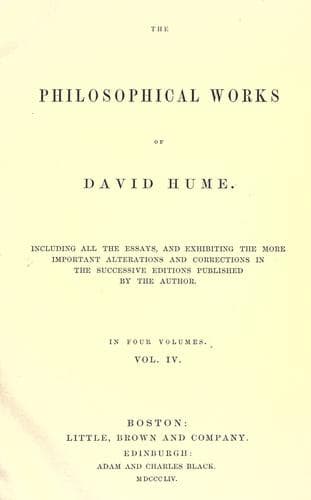
Philosophical Works, v. 1 (of 4): Including All the Essays, and Exhibiting the More Important Alterations and Corrections in the Successive Editions Published by the AuthorHume, David
PhilosophyPhilosophy
Philosophical Works, v. 1 (of 4): Including All the Essays, and Exhibiting the More Important Alterations and Corrections in the Successive Editions Published by the Author
Hume, David
Knowledge, Theory of; Philosophy, English -- 18th century
I doubt not but it will readily be allowed by the most obstinate
defender of the doctrine of infinite divisibility, that these arguments
are difficulties, and that 'tis impossible to give any answer to
them which will be perfectly clear and satisfactory. But here we may
observe, that nothing can be more absurd than this custom of calling a
_difficulty_ what pretends to be a _demonstration_, and endeavouring by
that means to elude its force and evidence. 'Tis not in demonstrations,
as in probabilities, that difficulties can take place, and one argument
counterbalance another, and diminish its authority. A demonstration,
if just, admits of no opposite difficulty; and if not just, 'tis
a mere sophism, and consequently can never be a difficulty. 'Tis
either irresistible, or has no manner of force. To talk therefore of
objections and replies, and balancing of arguments in such a question
as this, is to confess, either that human reason is nothing but a
play of words, or that the person himself, who talks so, has not a
capacity equal to such subjects. Demonstrations may be difficult to be
comprehended, because of the abstractedness of the subject; but can
never have any such difficulties as will weaken their authority, when
once they are comprehended.
'Tis true, mathematicians are wont to say, that there are here
equally strong arguments on the other side of the question, and that
the doctrine of indivisible points is also liable to unanswerable
objections. Before I examine these arguments and objections in detail,
I will here take them in a body, and endeavour, by a short and decisive
reason, to prove, at once, that 'tis utterly impossible they can have
any just foundation.
'Tis an established maxim in metaphysics, _That whatever the mind
clearly conceives includes the idea of possible existence_, or, in
other words, _that nothing we imagine is absolutely impossible_. We
can form the idea of a golden mountain, and from thence conclude, that
such a mountain may actually exist. We can form no idea of a mountain
without a valley, and therefore regard it as impossible.
Now 'tis certain we have an idea of extension; for otherwise, why
do we talk and reason concerning it? 'Tis likewise certain, that
this idea, as conceived by the imagination, though divisible into
parts or inferior ideas, is not infinitely divisible, nor consists
of an infinite number of parts: for that exceeds the comprehension
of our limited capacities. Here then is an idea of extension, which
consists of parts or inferior ideas, that are perfectly indivisible:
consequently this idea implies no contradiction: consequently 'tis
possible for extension really to exist conformable to it: and
consequently, all the arguments employed against the possibility of
mathematical points are mere scholastic quibbles, and unworthy of our
attention.
Public-domain text, read in full here on John Shaqi.
Reviews
Reviews
No reviews yet
Be the first to share your thoughts on this work.
Elsewhere in the archive
Join the Discussion
Join the discussion
Sign in to leave a comment or review.
Sign InorCreate an account