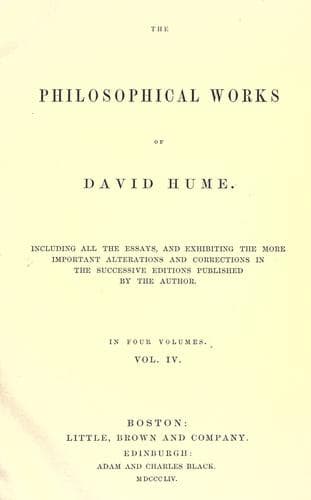
Philosophical Works, v. 1 (of 4): Including All the Essays, and Exhibiting the More Important Alterations and Corrections in the Successive Editions Published by the AuthorHume, David
PhilosophyPhilosophy
Philosophical Works, v. 1 (of 4): Including All the Essays, and Exhibiting the More Important Alterations and Corrections in the Successive Editions Published by the Author
Hume, David
Knowledge, Theory of; Philosophy, English -- 18th century
The idea of space is conveyed to the mind by two senses, the
sight and touch; nor does any thing ever appear extended, that is
not either visible or tangible. That compound impression, which
represents extension, consists of several lesser impressions, that
are indivisible to the eye or feeling, and may be called impressions
of atoms or corpuscles endowed with colour and solidity. But this
is not all. 'Tis not only requisite that these atoms should be
coloured or tangible, in order to discover themselves to our senses,
'tis also necessary we should preserve the idea of their colour or
tangibility, in order to comprehend them by our imagination. There is
nothing but the idea of their colour or tangibility which can render
them conceivable by the mind. Upon the removal of the ideas of these
sensible qualities they are utterly annihilated to the thought or
imagination.
Now, such as the parts are, such is the whole. If a point be not
considered as coloured or tangible, it can convey to us no idea; and
consequently the idea of extension, which is composed of the ideas of
these points, can never possibly exist: but if the idea of extension
really can exist, as we are conscious it does, its parts must also
exist; and in order to that, must be considered as coloured or
tangible. We have therefore no idea of space or extension, but when we
regard it as an object either of our sight or feeling.
The same reasoning will prove, that the indivisible moments of time
must be filled with some real object or existence, whose succession
forms the duration, and makes it be conceivable by the mind.
[3] Mr Locke.
[4] Sect. 5.
SECTION IV.
OBJECTIONS ANSWERED.
Our system concerning space and time consists of two parts, which
are intimately connected together. The first depends on this chain
of reasoning. The capacity of the mind is not infinite, consequently
no idea of extension or duration consists of an infinite number of
parts or inferior ideas, but of a finite number, and these simple
and indivisible: 'tis therefore possible for space and time to exist
conformable to this idea: and if it be possible, 'tis certain they
actually do exist conformable to it, since their infinite divisibility
is utterly impossible and contradictory.
Public-domain text, read in full here on John Shaqi.
Reviews
Reviews
No reviews yet
Be the first to share your thoughts on this work.
Elsewhere in the archive
Join the Discussion
Join the discussion
Sign in to leave a comment or review.
Sign InorCreate an account