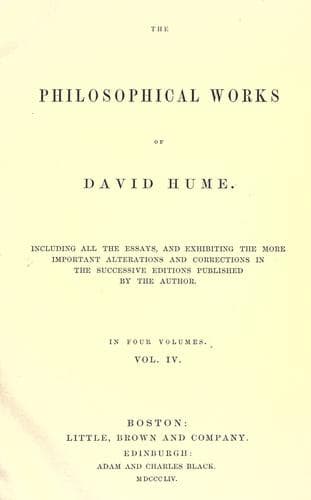
Philosophical Works, v. 1 (of 4): Including All the Essays, and Exhibiting the More Important Alterations and Corrections in the Successive Editions Published by the AuthorHume, David
PhilosophyPhilosophy
Philosophical Works, v. 1 (of 4): Including All the Essays, and Exhibiting the More Important Alterations and Corrections in the Successive Editions Published by the Author
Hume, David
Knowledge, Theory of; Philosophy, English -- 18th century
I know there are some who pretend that the idea of duration is
applicable in a proper sense to objects which are perfectly
unchangeable; and this I take to be the common opinion of philosophers
as well as of the vulgar. But to be convinced of its falsehood, we need
but reflect on the foregoing conclusion, that the idea of duration is
always derived from a succession of changeable objects, and can never
be conveyed to the mind by any thing stedfast and unchangeable. For
it inevitably follows from thence, that since the idea of duration
cannot be derived from such an object, it can never in any propriety or
exactness be applied to it, nor can any thing unchangeable be ever said
to have duration. Ideas always represent the objects or impressions,
from which they are derived, and can never, without a fiction,
represent or be applied to any other. By what fiction we apply the idea
of time, even to what is unchangeable, and suppose, as is common that
duration is a measure of rest as well as of motion, we shall consider
afterwards.[4]
There is another very decisive argument, which establishes the present
doctrine concerning our ideas of space and time, and is founded only on
that simple principle, _that our ideas of them are compounded of parts,
which are indivisible_. This argument may be worth the examining.
Every idea that is distinguishable being also separable, let us
take one of those simple indivisible ideas, of which the compound
one of _extension_ is formed, and separating it from all others,
and considering it apart, let us form a judgment of its nature and
qualities.
'Tis plain it is not the idea of extension: for the idea of extension
consists of parts; and this idea, according to the supposition, is
perfectly simple and indivisible. Is it therefore nothing? That is
absolutely impossible. For as the compound idea of extension, which
is real, is composed of such ideas, were these so many nonentities
there would be a real existence composed of nonentities, which is
absurd. Here, therefore, I must ask, _What is our idea of a simple and
indivisible point_? No wonder if my answer appear somewhat new, since
the question itself has scarce ever yet been thought of. We are wont
to dispute concerning the nature of mathematical points, but seldom
concerning the nature of their ideas.
Public-domain text, read in full here on John Shaqi.
Reviews
Reviews
No reviews yet
Be the first to share your thoughts on this work.
Elsewhere in the archive
Join the Discussion
Join the discussion
Sign in to leave a comment or review.
Sign InorCreate an account