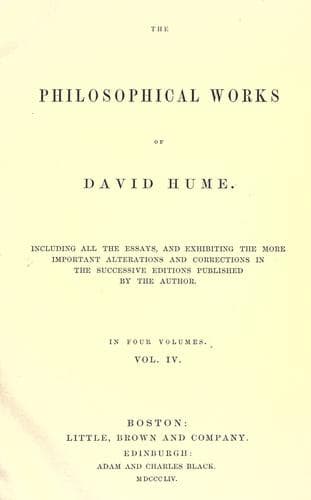
Philosophical Works, v. 1 (of 4): Including All the Essays, and Exhibiting the More Important Alterations and Corrections in the Successive Editions Published by the Author — John Shaqi
Philosophical Works, v. 1 (of 4): Including All the Essays, and Exhibiting the More Important Alterations and Corrections in the Successive Editions Published by the AuthorHume, David
PhilosophyPhilosophy
Philosophical Works, v. 1 (of 4): Including All the Essays, and Exhibiting the More Important Alterations and Corrections in the Successive Editions Published by the Author
Hume, David
Knowledge, Theory of; Philosophy, English -- 18th century
"Yesterday about four o'clock afternoon, Mr Hume expired. The near
approach of his death became evident in the night between Thursday
and Friday, when his disease became excessive, and soon weakened him
so much, that he could no longer rise out of his bed. He continued to
the last perfectly sensible, and free from much pain or feelings of
distress. He never dropped the smallest expression of impatience; but
when he had occasion to speak to the people about him, always did it
with affection and tenderness. I thought it improper to write to bring
you over, especially as I heard that he had dictated a letter to you
desiring you not to come. When he became very weak, it cost him an
effort to speak, and he died in such a happy composure of mind, that
nothing could exceed it."
Thus died our most excellent, and never to be forgotten friend;
concerning whose philosophical opinions men will, no doubt, judge
variously, every one approving, or condemning them, according as they
happen to coincide or disagree with his own; but concerning whose
character and conduct there can scarce be a difference of opinion.
His temper, indeed, seemed to be more happily balanced, if I may be
allowed such an expression, than that perhaps of any other man I have
ever known. Even in the lowest state of his fortune, his great and
necessary frugality never hindered him from exercising, upon proper
occasions, acts both of charity and generosity. It was a frugality
founded, not upon avarice, but upon the love of independency. The
extreme gentleness of his nature never weakened either the firmness of
his mind, or the steadiness of his resolutions. His constant pleasantry
was the genuine effusion of good nature and good humour, tempered
with delicacy and modesty, and without even the slightest tincture of
malignity, so frequently the disagreeable source of what is called wit
in other men. It never was the meaning of his raillery to mortify;
and therefore, far from offending, it seldom failed to please and
delight, even those who were the objects of it. To his friends, who
were frequently the objects of it, there was not perhaps any one of all
his great and amiable qualities, which contributed more to endear his
conversation. And that gaiety of temper, so agreeable in society, but
which is so often accompanied with frivolous and superficial qualities,
was in him certainly attended with the most severe application, the
most extensive learning, the greatest depth of thought, and a capacity
in every respect the most comprehensive. Upon the whole, I have
always considered him, both in his lifetime and since his death, as
approaching as nearly to the idea of a perfectly wise and virtuous man,
as perhaps the nature of human frailty will permit.
I ever am, dear Sir,
Most affectionately yours,
ADAM SMITH.
[Illustration: Drawn by A. Nasmyth--Engraved by W. Miller--HUME'S
MONUMENT, CALTON HILL.]
Public-domain text, read in full here on John Shaqi.
Reviews
Reviews
No reviews yet
Be the first to share your thoughts on this work.
Join the Discussion
Join the discussion
Sign in to leave a comment or review.
Sign InorCreate an account