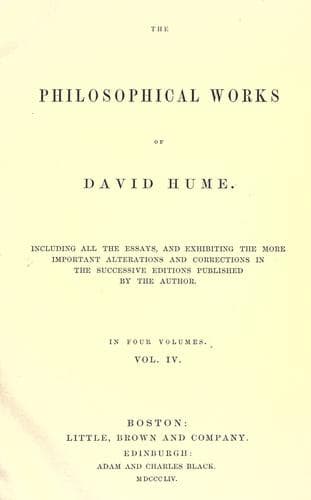
Philosophical Works, v. 1 (of 4): Including All the Essays, and Exhibiting the More Important Alterations and Corrections in the Successive Editions Published by the AuthorHume, David
PhilosophyPhilosophy
Philosophical Works, v. 1 (of 4): Including All the Essays, and Exhibiting the More Important Alterations and Corrections in the Successive Editions Published by the Author
Hume, David
Knowledge, Theory of; Philosophy, English -- 18th century
Thus, in advancing, we have insensibly discovered a new relation
betwixt cause and effect when we least expected it, and were entirely
employed upon another subject. This relation is their _constant
conjunction_. Contiguity and succession are not sufficient to make us
pronounce any two objects to be cause and effect, unless we perceive
that these two relations are preserved in several instances. We may
now see the advantage of quitting the direct survey of this relation,
in order to discover the nature of that _necessary connexion_ which
makes so essential a part of it. There are hopes, that by this means
we may at last arrive at our proposed end; though, to tell the truth,
this new-discovered relation of a constant conjunction seems to
advance us but very little in our way. For it implies no more than
this, that like objects have always been placed in like relations of
contiguity and succession; and it seems evident, at least at first
sight, that by this means we can never discover any new idea, and can
only multiply, but not enlarge, the objects of our mind. It may be
thought, that what we learn not from one object, we can never learn
from a hundred, which are all of the same kind, and are perfectly
resembling in every circumstance. As our senses show us in one instance
two bodies, or motions, or qualities in certain relations of succession
and contiguity, so our memory presents us only with a multitude of
instances wherein we always find like bodies, motions, or qualities,
in like relations. From the mere repetition of any past impression,
even to infinity, there never will arise any new original idea, such
as that of a necessary connexion; and the number of impressions has in
this case no more effect than if we confined ourselves to one only. But
though this reasoning seems just and obvious, yet, as it would be folly
to despair too soon, we shall continue the thread of our discourse;
and having found, that after the discovery of the constant conjunction
of any objects, we always draw an inference from one object to
another, we shall now examine the nature of that inference, and of the
transition from the impression to the idea. Perhaps 'twill appear in
the end, that the necessary connexion depends on the inference, instead
of the inference's depending on the necessary connexion.
Public-domain text, read in full here on John Shaqi.
Reviews
Reviews
No reviews yet
Be the first to share your thoughts on this work.
Elsewhere in the archive
Join the Discussion
Join the discussion
Sign in to leave a comment or review.
Sign InorCreate an account