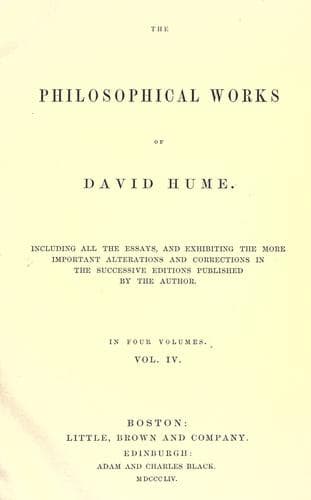
Philosophical Works, v. 1 (of 4): Including All the Essays, and Exhibiting the More Important Alterations and Corrections in the Successive Editions Published by the AuthorHume, David
PhilosophyPhilosophy
Philosophical Works, v. 1 (of 4): Including All the Essays, and Exhibiting the More Important Alterations and Corrections in the Successive Editions Published by the Author
Hume, David
Knowledge, Theory of; Philosophy, English -- 18th century
Since it appears, that the transition from an impression present to
the memory or senses to the idea of an object, which we call cause or
effect, is founded on past _experience_, and on our remembrance of
their _constant conjunction_, the next question is, whether experience
produces the idea by means of the understanding or imagination; whether
we are determined by reason to make the transition, or by a certain
association and relation of perceptions. If reason determined us, it
would proceed upon that principle, _that instances, of which we have
had no experience, must resemble those of which we have had experience,
and that the course of nature continues always uniformly the same._
In order, therefore, to clear up this matter, let us consider all the
arguments upon which such a proposition may be supposed to be founded;
and as these must be derived either from _knowledge_ or _probability_,
let us cast our eye on each of these degrees of evidence, and see
whether they afford any just conclusion of this nature.
Our foregoing method of reasoning will easily convince us, that there
can be no _demonstrative_ arguments to prove, _that those instances
of which we have had no experience resemble those of which we have
had experience_. We can at least conceive a change in the course of
nature; which sufficiently proves that such a change is not absolutely
impossible. To form a clear idea of any thing is an undeniable argument
for its possibility, and is alone a refutation of any pretended
demonstration against it.
Probability, as it discovers not the relations of ideas, considered
as such, but only those of objects, must in some respects be founded
on the impressions of our memory and senses, and in some respects on
our ideas. Were there no mixture of any impression in our probable
reasonings, the conclusion would be entirely chimerical: and were there
no mixture of ideas, the action of the mind, in observing the relation,
would, properly speaking, be sensation, not reasoning. 'Tis therefore
necessary, that in all probable reasonings there be something present
to the mind, either seen or remembered; and that from this we infer
something connected with it, which is not seen nor remembered.
Public-domain text, read in full here on John Shaqi.
Reviews
Reviews
No reviews yet
Be the first to share your thoughts on this work.
Elsewhere in the archive
Join the Discussion
Join the discussion
Sign in to leave a comment or review.
Sign InorCreate an account