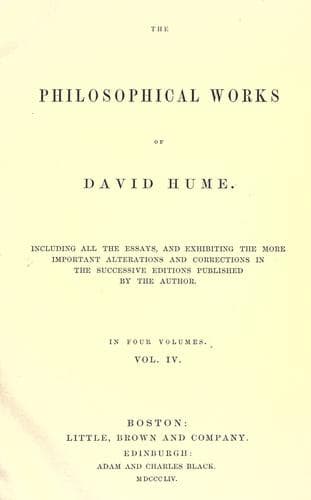
Philosophical Works, v. 1 (of 4): Including All the Essays, and Exhibiting the More Important Alterations and Corrections in the Successive Editions Published by the AuthorHume, David
PhilosophyPhilosophy
Philosophical Works, v. 1 (of 4): Including All the Essays, and Exhibiting the More Important Alterations and Corrections in the Successive Editions Published by the Author
Hume, David
Knowledge, Theory of; Philosophy, English -- 18th century
It shall therefore be allowed for at moment, that the production of one
object by another in any one instance implies a power; and that this
power is connected with its effect. But it having been already proved,
that the power lies not in the sensible qualities of the cause; and
there being nothing but the sensible qualities present to us; I ask,
why in other instances you presume that the same power still exists,
merely upon the appearance of these qualities? Your appeal to past
experience decides nothing in the present case; and at the utmost
can only prove, that that very object, which produced any other, was
at that very instant endowed with such a power; but can never prove,
that the same power must continue in the same object or collection of
sensible qualities; much less, that a like power is always conjoined
with like sensible qualities. Should it be said, that we have
experience, that the same power continues united with the same object,
and that like objects are endowed with like powers, I would renew my
question, _why from this experience we form any conclusion beyond those
past instances, of which we have had experience_? If you answer this
question in the same manner as the preceding, your answer gives still
occasion to a new question of the same kind, even _in infinitum_; which
clearly proves, that the foregoing reasoning had no just foundation.
Thus, not only our reason fails us in the discovery of the _ultimate
connexion_ of causes and effects, but even after experience has
informed us of their _constant conjunction_, 'tis impossible for
us to satisfy ourselves by our reason, why we should extend that
experience beyond those particular instances which have fallen under
our observation. We suppose, but are never able to prove, that there
must be a resemblance betwixt those objects, of which we have had
experience, and those which lie beyond the reach of our discovery.
We have already taken notice of certain relations, which make us pass
from one object to another, even though there be no reason to determine
us to that transition; and this we may establish for a general rule,
that wherever the mind constantly and uniformly makes a transition
without any reason, it is influenced by these relations. Now, this is
exactly the present case. Reason can never show us the connexion of one
object with another, though aided by experience, and the observation
of their constant conjunction in all past instances. When the mind
therefore passes from the idea or impression of one object to the idea
or belief of another, it is not determined by reason, but by certain
principles, which associate together the ideas of these objects, and
unite them in the imagination. Had ideas no more union in the fancy,
than objects seem to have to the understanding, we could never draw any
inference from causes to effects, nor repose belief in any matter of
fact. The inference therefore depends solely on the union of ideas.
Public-domain text, read in full here on John Shaqi.
Reviews
Reviews
No reviews yet
Be the first to share your thoughts on this work.
Elsewhere in the archive
Join the Discussion
Join the discussion
Sign in to leave a comment or review.
Sign InorCreate an account