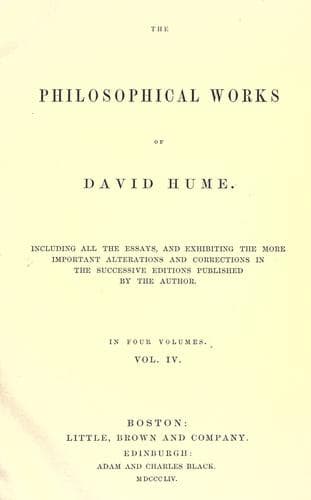
Philosophical Works, v. 1 (of 4): Including All the Essays, and Exhibiting the More Important Alterations and Corrections in the Successive Editions Published by the AuthorHume, David
PhilosophyPhilosophy
Philosophical Works, v. 1 (of 4): Including All the Essays, and Exhibiting the More Important Alterations and Corrections in the Successive Editions Published by the Author
Hume, David
Knowledge, Theory of; Philosophy, English -- 18th century
The only connexion or relation of objects, which can lead us beyond
the immediate impressions of our memory and senses, is that of cause
and effect; and that because 'tis the only one, on which we can found
a just inference from one object to another. The idea of cause and
effect is derived from _experience_, which informs us, that such
particular objects, in all past instances, have been constantly
conjoined with each other: and as an object similar to one of these
is supposed to be immediately present in its impression, we thence
presume on the existence of one similar to its usual attendant.
According to this account of things, which is, I think, in every
point unquestionable, probability is founded on the presumption of a
resemblance betwixt those objects of which we have had experience, and
those of which we have had none; and therefore 'tis impossible this
presumption can arise from probability. The same principle cannot be
both the cause and effect of another; and this is, perhaps, the only
proposition concerning that relation, which is either intuitively or
demonstratively certain.
Should any one think to elude this argument; and without determining
whether our reasoning on this subject be derived from demonstration or
probability, pretend that all conclusions from causes and effects are
built on solid reasoning: I can only desire that this reasoning may be
produced, in order to be exposed to our examination. It may perhaps
be said, that after experience of the constant conjunction of certain
objects, we reason in the following manner. Such an object is always
found to produce another. 'Tis impossible it could have this effect, if
it was not endowed with a power of production. The power necessarily
implies the effect; and therefore there is a just foundation for
drawing a conclusion from the existence of one object to that of its
usual attendant. The past production implies a power: the power implies
a new production: and the new production is what we infer from the
power and the past production.
'Twere easy for me to show the weakness of this reasoning, were I
willing to make use of those observations I have already made, that
the idea of _production_ is the same with that of _causation_, and
that no existence certainly and demonstratively implies a power in
any other object; or were it proper to anticipate what I shall have
occasion to remark afterwards concerning the idea we form of _power_
and _efficacy_. But as such a method of proceeding may seem either to
weaken my system, by resting one part of it on another, or to breed a
confusion in my reasoning, I shall endeavour to maintain my present
assertion without any such assistance.
Public-domain text, read in full here on John Shaqi.
Reviews
Reviews
No reviews yet
Be the first to share your thoughts on this work.
Elsewhere in the archive
Join the Discussion
Join the discussion
Sign in to leave a comment or review.
Sign InorCreate an account