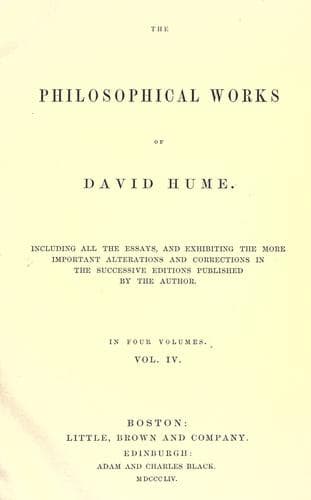
Philosophical Works, v. 1 (of 4): Including All the Essays, and Exhibiting the More Important Alterations and Corrections in the Successive Editions Published by the AuthorHume, David
PhilosophyPhilosophy
Philosophical Works, v. 1 (of 4): Including All the Essays, and Exhibiting the More Important Alterations and Corrections in the Successive Editions Published by the Author
Hume, David
Knowledge, Theory of; Philosophy, English -- 18th century
If, in considering the nature of relation, and that facility of
transition which is essential to it, we can satisfy ourselves
concerning the reality of this phenomenon, 'tis well: but I must
confess I place my chief confidence in experience to prove so material
a principle. We may therefore observe, as the first experiment to our
present purpose, that upon the appearance of the picture of an absent
friend, our idea of him is evidently enlivened by the _resemblance_,
and that every passion, which that idea occasions, whether of joy or
sorrow, acquires new force and vigour. In producing this effect there
concur both a relation and a present impression. Where the picture
bears him no resemblance, or at least was not intended for him, it
never so much as conveys our thought to him: and where it is absent as
well as the person; though the mind may pass from the thought of the
one to that of the other; it feels its idea to be rather weakened than
enlivened by that transition. We take a pleasure in viewing the picture
of a friend, when 'tis set before us; but when 'tis removed, rather
choose to consider him directly, than by reflection in an image, which
is equally distant and obscure.
The ceremonies of the Roman Catholic religion may be considered
as experiments of the same nature. The devotees of that strange
superstition usually plead in excuse of the mummeries with which they
are up-braided, that they feel the good effect of those external
motions, and postures and actions, in enlivening their devotion, and
quickening their fervour, which otherwise would decay away, if directed
entirely to distant and immaterial objects. We shadow out the objects
of our faith, say they, in sensible types and images, and render
them more present to us by the immediate presence of these types,
than 'tis possible for us to do, merely by an intellectual view and
contemplation. Sensible objects have always a greater influence on the
fancy than any other; and this influence they readily convey to those
ideas to which they are related, and which they resemble. I shall only
infer from these practices, and this reasoning, that the effect of
resemblance in enlivening the idea is very common; and as in every case
a resemblance and a present impression must concur, we are abundantly
supplied with experiments to prove the reality of the foregoing
principle.
Public-domain text, read in full here on John Shaqi.
Reviews
Reviews
No reviews yet
Be the first to share your thoughts on this work.
Elsewhere in the archive
Join the Discussion
Join the discussion
Sign in to leave a comment or review.
Sign InorCreate an account