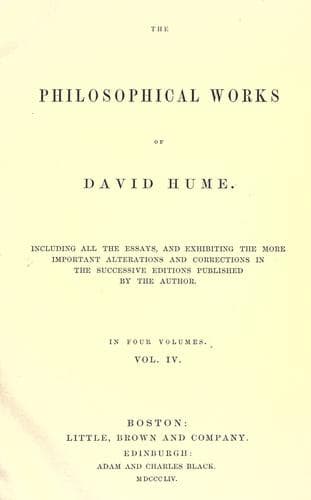
Philosophical Works, v. 1 (of 4): Including All the Essays, and Exhibiting the More Important Alterations and Corrections in the Successive Editions Published by the AuthorHume, David
PhilosophyPhilosophy
Philosophical Works, v. 1 (of 4): Including All the Essays, and Exhibiting the More Important Alterations and Corrections in the Successive Editions Published by the Author
Hume, David
Knowledge, Theory of; Philosophy, English -- 18th century
We may add force to these experiments by others of a different
kind, in considering the effects of _contiguity_, as well as of
_resemblance_.'Tis certain that distance diminishes the force of
every idea; and that, upon our approach to any object, though it does
not discover itself to our senses, it operates upon the mind with an
influence that imitates an immediate impression. The thinking on any
object readily transports the mind to what is contiguous; but 'tis
only the actual presence of an object, that transports it with a
superior vivacity. When I am a few miles from home, whatever relates
to it touches me more nearly than when I am two hundred leagues
distant; though even at that distance the reflecting on any thing in
the neighbourhood of my friends and family naturally produces an idea
of them. But as in this latter case, both the objects of the mind are
ideas; notwithstanding there is an easy transition betwixt them; that
transition alone is not able to give a superior vivacity to any of the
ideas, for want of some immediate impression.[7]
No one can doubt but causation has the same influence as the other
two relations of resemblance and contiguity. Superstitious people are
fond of the relicks of saints and holy men, for the same reason that
they seek after types and images, in order to enliven their devotion,
and give them a more intimate and strong conception of those exemplary
lives, which they desire to imitate. Now, 'tis evident one of the best
relicks a devotee could procure would be the handy-work of a saint;
and if his clothes and furniture are ever to be considered in this
light, 'tis because they were once at his disposal, and were moved
and affected by him; in which respect they are to be considered as
imperfect effects, and as connected with him by a shorter chain of
consequences than any of those, from which we learn the reality of his
existence. This phenomenon clearly proves, that a present impression
with a relation of causation may enliven any idea, and consequently
produce belief or assent, according to the precedent definition of it.
Public-domain text, read in full here on John Shaqi.
Reviews
Reviews
No reviews yet
Be the first to share your thoughts on this work.
Elsewhere in the archive
Join the Discussion
Join the discussion
Sign in to leave a comment or review.
Sign InorCreate an account