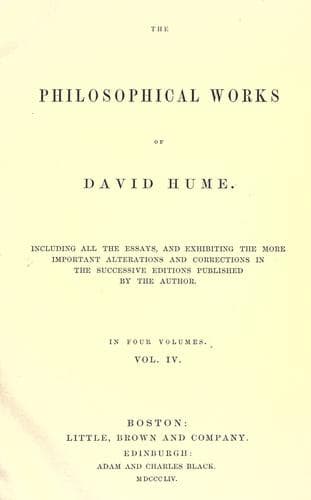
Philosophical Works, v. 1 (of 4): Including All the Essays, and Exhibiting the More Important Alterations and Corrections in the Successive Editions Published by the AuthorHume, David
PhilosophyPhilosophy
Philosophical Works, v. 1 (of 4): Including All the Essays, and Exhibiting the More Important Alterations and Corrections in the Successive Editions Published by the Author
Hume, David
Knowledge, Theory of; Philosophy, English -- 18th century
'Twill here be worth our observation, that the past experience, on
which all our judgments concerning cause and effect depend, may operate
on our mind in such an insensible manner as never to be taken notice
of, and may even in some measure be unknown to us. A person, who stops
short in his journey upon meeting a river in his way, foresees the
consequences of his proceeding forward; and his knowledge of these
consequences is conveyed to him by past experience, which informs him
of such certain conjunctions of causes and effects. But can we think,
that on this occasion he reflects on any past experience, and calls
to remembrance instances that he has seen or heard of, in order to
discover the effects of water on animal bodies? No, surely; this is not
the method, in which he proceeds in his reasoning. The idea of sinking
is so closely connected with that of water, and the idea of suffocating
with that of sinking, that the mind makes the transition without the
assistance of the memory. The custom operates before we have time for
reflection. The objects seem so inseparable, that we interpose not
a moment's delay in passing from the one or the other. But as this
transition proceeds from experience, and not from any primary connexion
betwixt the ideas, we must necessarily acknowledge, that experience may
produce a belief and a judgment of causes and effects by a separate
operation, and without being once thought of. This removes all pretext,
if there yet remains any, for asserting that the mind is convinced
by reasoning of that principle, _that instances of which we have no
experience, must necessarily resemble those of which we have_. For we
here find, that the understanding or imagination can draw inferences
from past experience, without reflecting on it; much more without
forming any principle concerning it, or reasoning upon that principle.
Public-domain text, read in full here on John Shaqi.
Reviews
Reviews
No reviews yet
Be the first to share your thoughts on this work.
Elsewhere in the archive
Join the Discussion
Join the discussion
Sign in to leave a comment or review.
Sign InorCreate an account