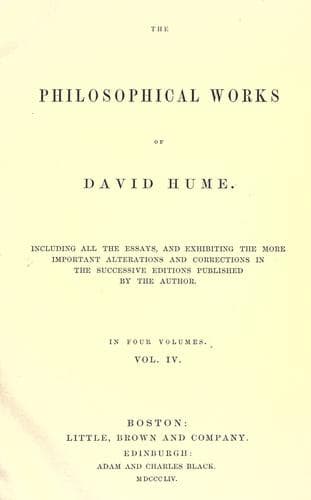
Philosophical Works, v. 1 (of 4): Including All the Essays, and Exhibiting the More Important Alterations and Corrections in the Successive Editions Published by the AuthorHume, David
PhilosophyPhilosophy
Philosophical Works, v. 1 (of 4): Including All the Essays, and Exhibiting the More Important Alterations and Corrections in the Successive Editions Published by the Author
Hume, David
Knowledge, Theory of; Philosophy, English -- 18th century
From a second observation I conclude, that the belief which attends the
present impression, and is produced by a number of past impressions and
conjunctions; that this belief, I say, arises immediately, without any
new operation of the reason or imagination. Of this I can be certain,
because I never am conscious of any such operation, and find nothing
in the subject on which it can be founded. Now, as we call every
thing _custom_ which proceeds from a past repetition, without any new
reasoning or conclusion, we may establish it as a certain truth, that
all the belief, which follows upon any present impression, is derived
solely from that origin. When we are accustomed to see two impressions
conjoined together, the appearance or idea of the one immediately
carries us to the idea of the other.
Being fully satisfied on this head, I make a third set of experiments,
in order to know whether any thing be requisite, beside the customary
transition, towards the production of this phenomenon of belief. I
therefore change the first impression into an idea; and observe, that
though the customary transition to the correlative idea still remains,
yet there is in reality no belief nor persuasion. A present impression,
then, is absolutely requisite to this whole operation; and when after
this I compare an impression with an idea, and find that their only
difference consists in their different degrees of force and vivacity,
I conclude upon the whole, that belief is a more vivid and intense
conception of an idea, proceeding from its relation to a present
impression.
Thus, all probable reasoning is nothing but a species of sensation.
'Tis not solely in poetry and music we must follow our taste and
sentiment, but likewise in philosophy. When I am convinced of any
principle, 'tis only an idea which strikes more strongly upon me. When
I give the preference to one set of arguments above another, I do
nothing but decide from my feeling concerning the superiority of their
influence. Objects have no discoverable connexion together; nor is it
from any other principle but custom operating upon the imagination,
that we can draw any inference from the appearance of one to the
existence of another.
Public-domain text, read in full here on John Shaqi.
Reviews
Reviews
No reviews yet
Be the first to share your thoughts on this work.
Elsewhere in the archive
Join the Discussion
Join the discussion
Sign in to leave a comment or review.
Sign InorCreate an account