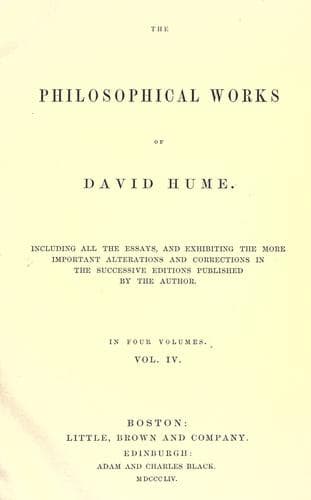
Philosophical Works, v. 1 (of 4): Including All the Essays, and Exhibiting the More Important Alterations and Corrections in the Successive Editions Published by the AuthorHume, David
PhilosophyPhilosophy
Philosophical Works, v. 1 (of 4): Including All the Essays, and Exhibiting the More Important Alterations and Corrections in the Successive Editions Published by the Author
Hume, David
Knowledge, Theory of; Philosophy, English -- 18th century
And indeed the want of resemblance in this case so entirely destroys
belief, that except those few who, upon cool reflection on the
importance of the subject, have taken care by repeated meditation
to imprint in their minds the arguments for a future state, there
scarce are any who believe the immortality of the soul with a true
and established judgment; such as is derived from the testimony of
travellers and historians. This appears very conspicuously wherever
men have occasion to compare the pleasures and pains, the rewards and
punishments of this life with those of a future; even though the case
does not concern themselves, and there is no violent passion to disturb
their judgment. The Roman Catholics are certainly the most zealous of
any sect in the Christian world; and yet you'll find few among the
more sensible part of that communion who do not blame the Gunpowder
Treason, and the massacre of St Bartholomew, as cruel and barbarous,
though projected or executed against those very people, whom without
any scruple they condemn to eternal and infinite punishments. All we
can say in excuse for this inconsistency is, that they really do not
believe what they affirm concerning a future state; nor is there any
better proof of it than the very inconsistency.
We may add to this a remark, that in matters of religion men take a
pleasure in being terrified, and that no preachers are so popular as
those who excite the most dismal and gloomy passions. In the common
affairs of life, where we feel and are with the solidity of the
subject, nothing can be more disagreeable than fear and terror; and
'tis only in dramatic performances and in religious discourses that
they ever give pleasure. In these latter cases the imagination reposes
itself indolently on the idea; and the passion being softened by the
want of belief in the subject, has no more than the agreeable effect of
enlivening the mind and fixing the attention.
Public-domain text, read in full here on John Shaqi.
Reviews
Reviews
No reviews yet
Be the first to share your thoughts on this work.
Elsewhere in the archive
Join the Discussion
Join the discussion
Sign in to leave a comment or review.
Sign InorCreate an account