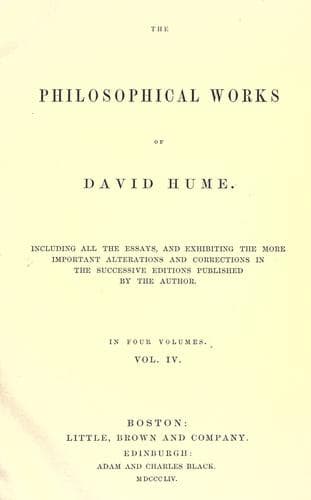
Philosophical Works, v. 1 (of 4): Including All the Essays, and Exhibiting the More Important Alterations and Corrections in the Successive Editions Published by the AuthorHume, David
PhilosophyPhilosophy
Philosophical Works, v. 1 (of 4): Including All the Essays, and Exhibiting the More Important Alterations and Corrections in the Successive Editions Published by the Author
Hume, David
Knowledge, Theory of; Philosophy, English -- 18th century
The present hypothesis will receive additional confirmation, if we
examine the effects of other kinds of custom, as well as of other
relations. To understand this we must consider that custom, to which
I attribute all belief and reasoning, may operate upon the mind in
invigorating an idea after two several ways. For supposing that, in
all past experience, we have found two objects to have been always
conjoined together, 'tis evident, that upon the appearance of one of
these objects in an impression, we must, from custom, make an easy
transition to the idea of that object, which usually attends it; and
by means of the present impression and easy transition must conceive
that idea in a stronger and more lively manner than we do any loose
floating image of the fancy. But let us next suppose, that a mere idea
alone, without any of this curious and almost artificial preparation,
should frequently make its appearance in the mind, this idea must,
by degrees, acquire a facility and force; and both by its firm hold
and easy introduction distinguish itself from any new and unusual
idea. This is the only particular in which these two kinds of custom
agree; and if it appear that their effects on the judgment are similar
and proportionable, we may certainly conclude, that the foregoing
explication of that faculty is satisfactory. But can we doubt of this
agreement in their influence on the judgment, when we consider the
nature and effects of _education_?
All those opinions and notions of things, to which we have been
accustomed from our infancy, take such deep root, that 'tis impossible
for us, by all the powers of reason and experience, to eradicate them;
and this habit not only approaches in its influence, but even on
many occasions prevails over that which arises from the constant and
inseparable union of causes and effects. Here we must not be contented
with saying, that the vividness of the idea produces the belief:
we must maintain that they are individually the same. The frequent
repetition of any idea infixes it in the imagination; but could never
possibly of itself produce belief, if that act of the mind was, by the
original constitution of our natures, annexed only to a reasoning and
comparison of ideas. Custom may lead us into some false comparison
of ideas. This is the utmost effect we can conceive of it; but 'tis
certain it could never supply the place of that comparison, nor produce
any act of the mind which naturally belonged to that principle.
Public-domain text, read in full here on John Shaqi.
Reviews
Reviews
No reviews yet
Be the first to share your thoughts on this work.
Elsewhere in the archive
Join the Discussion
Join the discussion
Sign in to leave a comment or review.
Sign InorCreate an account