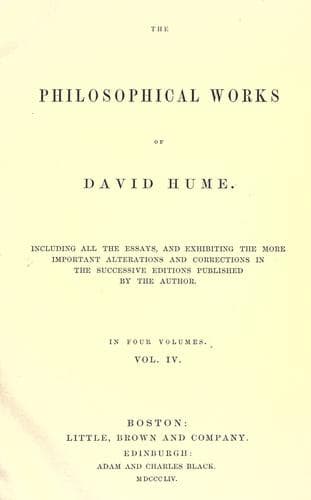
Philosophical Works, v. 1 (of 4): Including All the Essays, and Exhibiting the More Important Alterations and Corrections in the Successive Editions Published by the AuthorHume, David
PhilosophyPhilosophy
Philosophical Works, v. 1 (of 4): Including All the Essays, and Exhibiting the More Important Alterations and Corrections in the Successive Editions Published by the Author
Hume, David
Knowledge, Theory of; Philosophy, English -- 18th century
But though education be disclaimed by philosophy, as a fallacious
ground of assent to any opinion, it prevails nevertheless in the world,
and is the cause why all systems are apt to be rejected at first as
new and unusual. This, perhaps, will be the fate of what I have here
advanced concerning _belief_; and though the proofs I have produced
appear to me perfectly conclusive, I expect not to make many proselytes
to my opinion. Men will scarce ever be persuaded, that effects of
such consequence can flow from principles which are seemingly so
inconsiderable, and that the far greatest part of our reasonings, with
all our actions and passions, can be derived from nothing but custom
and habit. To obviate this objection, I shall here anticipate a little
what would more properly fall under our consideration afterwards, when
we come to treat of the Passions and the Sense of Beauty.
There is implanted in the human mind a perception of pain and pleasure,
as the chief spring and moving principle of all its actions. But pain
and pleasure have two ways of making their appearance in the mind;
of which the one has effects very different from the other. They may
either appear an impression to the actual feeling, or only in idea, as
at present when I mention them. 'Tis evident the influence of these
upon our actions is far from being equal. Impressions always actuate
the soul, and that in the highest degree; but 'tis not every idea which
has the same effect. Nature has proceeded with caution in this case,
and seems to have carefully avoided the inconveniences of two extremes.
Did impressions alone influence the will, we should every moment of
our lives be subject to the greatest calamities; because, though we
foresaw their approach, we should not be provided by nature with any
principle of action, which might impel us to avoid them. On the other
hand, did every idea influence our actions, our condition would not be
much mended. For such is the unsteadiness and activity of thought, that
the images of every thing, especially of goods and evils, are always
wandering in the mind; and were it moved by every idle conception of
this kind, it would never enjoy a moment's peace and tranquillity.
Public-domain text, read in full here on John Shaqi.
Reviews
Reviews
No reviews yet
Be the first to share your thoughts on this work.
Elsewhere in the archive
Join the Discussion
Join the discussion
Sign in to leave a comment or review.
Sign InorCreate an account