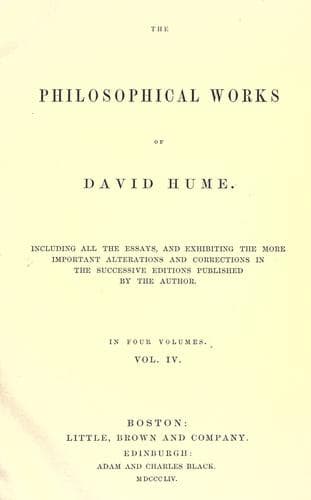
Philosophical Works, v. 1 (of 4): Including All the Essays, and Exhibiting the More Important Alterations and Corrections in the Successive Editions Published by the AuthorHume, David
PhilosophyPhilosophy
Philosophical Works, v. 1 (of 4): Including All the Essays, and Exhibiting the More Important Alterations and Corrections in the Successive Editions Published by the Author
Hume, David
Knowledge, Theory of; Philosophy, English -- 18th century
A person that has lost a leg or an arm by amputation endeavours for
a long time afterwards to serve himself with them. After the death
of any one, 'tis a common remark of the whole family, but especially
the servants, that they can scarce believe him to be dead, but still
imagine him to be in his chamber or in any other place, where they
were accustomed to find him. I have often heard in conversation, after
talking of a person that is any way celebrated, that one, who has no
acquaintance with him, will say, _I have never seen such a one, but
almost fancy I have, so often have I heard talk of him_. All these are
parallel instances.
If we consider this argument from _education_ in a proper light, 'twill
appear very convincing; and the more so, that 'tis founded on one
of the most common phenomena that is any where to be met with. I am
persuaded that, upon examination, we shall find more than one half of
those opinions that prevail among mankind to be owing to education, and
that the principles which are thus implicitly embraced, overbalance
those, which are owing either to abstract reasoning or experience.
As liars, by the frequent repetition of their lies, come at last to
remember them; so the judgment, or rather the imagination, by the like
means, may have ideas so strongly imprinted on it, and conceive them
in so full a light, that they may operate upon the mind in the same
manner with those which the senses, memory, or reason present to us.
But as education is an artificial and not a natural cause, and as its
maxims are frequently contrary to reason, and even to themselves in
different times and places, it is never upon that account recognised
by philosophers; though in reality it be built almost on the same
foundation of custom and repetition as our reasonings from causes and
effects.[8]
[8] In general we may observe, that as our assent to all probable
reasonings is founded on the vivacity of ideas, it resembles many
of those whimsies and prejudices which are rejected under the
opprobrious character of being the offspring of the imagination. By
this expression it appears, that the word imagination, is commonly used
in two different senses; and though nothing be more contrary to true
philosophy than this inaccuracy, yet, in the following reasonings, I
have often been obliged to fall into it. When I oppose the imagination
to the memory, I mean the faculty by which we form our fainter ideas.
When I oppose it to reason, I mean the same faculty, excluding only our
demonstrative and probable reasonings. When I oppose it to neither,
'tis indifferent whether it be taken in the larger or more limited
sense, or at least the context will sufficiently explain the meaning.
SECTION X.
OF THE INFLUENCE OF BELIEF.
Public-domain text, read in full here on John Shaqi.
Reviews
Reviews
No reviews yet
Be the first to share your thoughts on this work.
Elsewhere in the archive
Join the Discussion
Join the discussion
Sign in to leave a comment or review.
Sign InorCreate an account