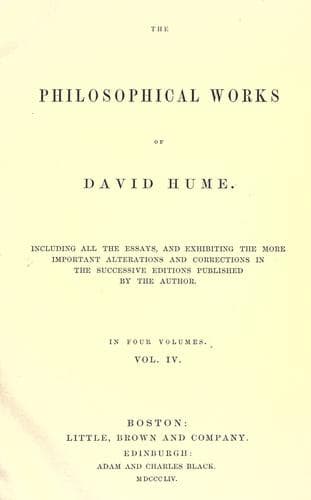
Philosophical Works, v. 1 (of 4): Including All the Essays, and Exhibiting the More Important Alterations and Corrections in the Successive Editions Published by the AuthorHume, David
PhilosophyPhilosophy
Philosophical Works, v. 1 (of 4): Including All the Essays, and Exhibiting the More Important Alterations and Corrections in the Successive Editions Published by the Author
Hume, David
Knowledge, Theory of; Philosophy, English -- 18th century
Even at the time when Mr Hume was employed in doing Mr Rousseau the
most essential service, he received from him the most insolent and
abusive letter. The more such a stroke was unexpected, the more it was
cruel and affecting. Mr Hume wrote an account of this extraordinary
adventure to his friends at Paris, and expressed himself in his letters
with all that indignation which so strange a proceeding must excite.
He thought himself under no obligation to keep terms with a man, who,
after having received from him the most certain and constant marks
of friendship, could reproach him, without any reason, as false,
treacherous, and as the most wicked of mankind.
In the mean time, the dispute between these two celebrated personages
did not fail to make a noise. The complaints of Mr Hume soon came to
the knowledge of the public, which at first hardly believed it possible
that Mr Rousseau could be guilty of that excessive ingratitude
laid to his charge. Even Mr Hume's friends were fearful, lest, in
the first effusions of sensibility, he was not carried too far, and
had not mistaken for wilful crimes of the heart, the vagaries of
the imagination, or the deceptions of the understanding. He judged
it necessary, therefore to explain the affair, by writing a precise
narrative of all that passed between him and Mr Rousseau, from
their first connection to their rupture. This narrative he sent to
his friends, some of whom advised him to print it, alleging, that
as Mr Rousseau's accusations were become public, the proofs of his
justification ought to be so too. Mr Hume did not give into these
arguments, choosing rather to run the risk of being unjustly censured,
than to resolve on making himself a public party in an affair so
contrary to his disposition and character. A new incident, however, at
length overcame his reluctance. Mr Rousseau had addressed a letter to
a bookseller at Paris, in which he directly accuses Mr Hume of having
entered into a league with his enemies to betray and defame him; and
in which he boldly defies Mr Hume to print the papers he had in his
hands. This letter was communicated to several persons in Paris, was
translated into English, and the translation printed in the public
papers in London. An accusation and defiance so very public could not
be suffered to pass without reply, while any long silence on the part
of Mr Hume might have been interpreted little in his favour.
Public-domain text, read in full here on John Shaqi.
Reviews
Reviews
No reviews yet
Be the first to share your thoughts on this work.
Join the Discussion
Join the discussion
Sign in to leave a comment or review.
Sign InorCreate an account